Walmart cuts 1,000 roles as it simplifies operations and expands tech focus
Walmart cut about 1,000 roles and pushed some staff to relocate, a sign Target workers should watch for more tech-led pruning of support jobs.

Walmart’s decision to eliminate about 1,000 roles is another reminder that big-box retail is trimming layers around the store while it concentrates more work in tech, delivery and marketplace businesses. Some affected employees were asked to relocate to Bentonville, Arkansas, or Northern California offices, a clue that the company is not just cutting headcount, but reshaping where its decision-makers sit and how work gets organized.
The changes come as Walmart’s new chief executive, John Furner, pushes a simpler operating structure. Executives Suresh Kumar and Daniel Danker told employees the company had spent the past year moving Walmart U.S., Sam’s Club and international operations toward a single shared platform. Their message was blunt: make ownership clearer, simplify how work is organized and line up roles with future needs. For workers on the front lines, that usually means the most vulnerable jobs are the ones that sit between headquarters and the sales floor, including duplicated support functions, regional layers and jobs that can be centralized.

That matters at Target because Target has been making its own version of the same tradeoff. On March 3, Target laid out an incremental $2 billion investment for 2026, including more than $1 billion in additional capital spending and $1 billion in operating investments. The plan called for more payroll and training, updated store floor plans and displays, and faster adoption of technology, including AI. In other words, Target is saying some work will get more support, while other work gets redesigned or absorbed by systems.
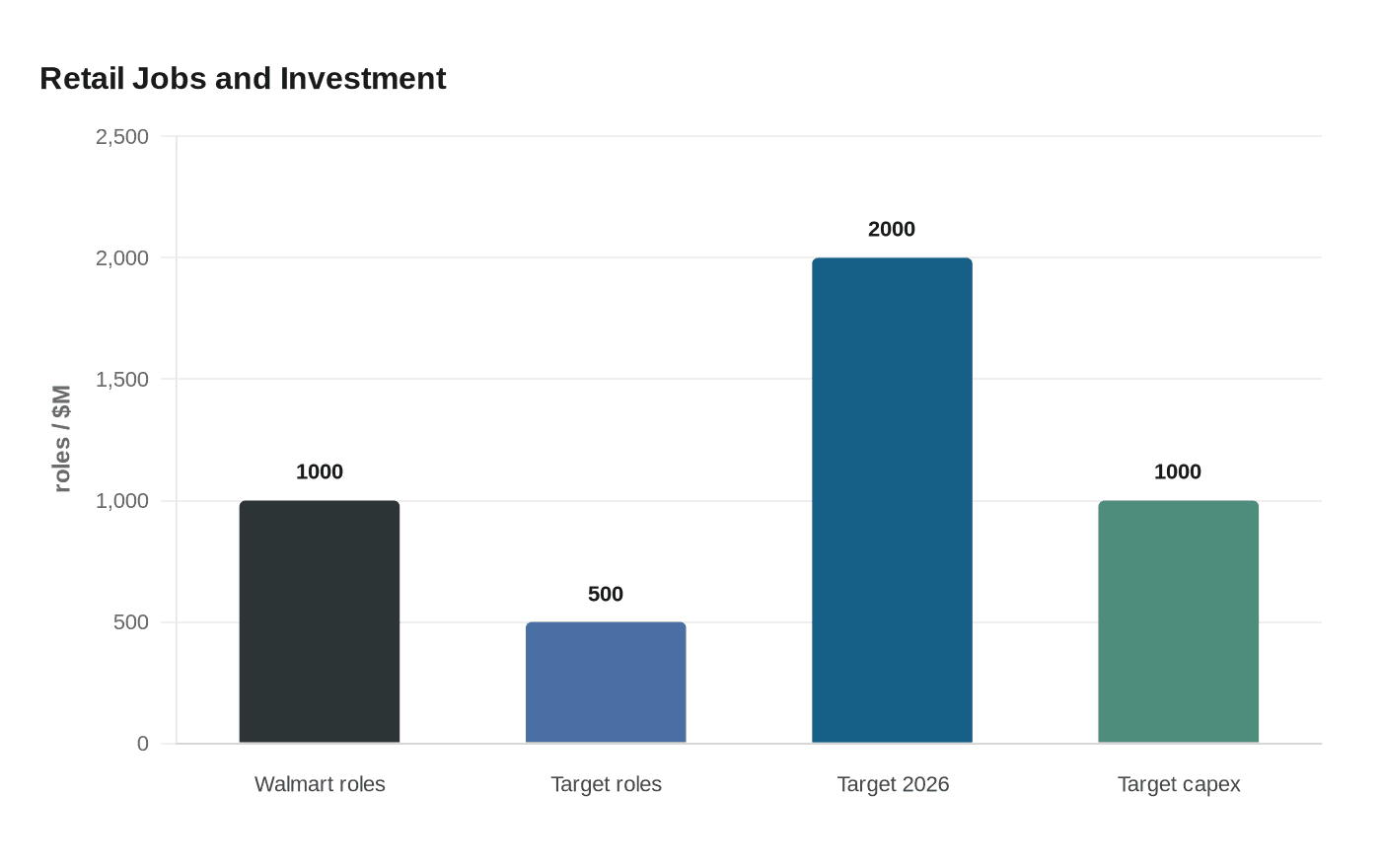
Target has already shown where the pressure points are. On February 9, the company said it would cut about 500 other roles at distribution centers and regional offices while increasing store staffing and reducing the number of store districts. A day later, Target named Lisa Roath as chief operating officer and Cara Sylvester as chief merchandising officer, while Rick Gomez was set to leave and Jill Sando to retire. That looks less like a broad retreat than a reshuffling of who owns execution, merchandising and store support.
For Target team members, the clearest takeaway is this: the safest jobs are likely to be the ones tied directly to guest experience, store execution, training and fulfillment work that cannot be easily standardized away. The most exposed roles are the ones that can be consolidated, centralized or replaced by software, especially in regional support, back-office coordination and layers of management that add little to the guest walk through the building. Walmart’s move shows the retail labor market is still tilting toward fewer organizers and more operators, and Target is adjusting to the same pressure.
Know something we missed? Have a correction or additional information?
Submit a Tip