Buddhist Monks Study Reveals Meditation Reshapes Brain Activity Patterns
Monks with 15,000+ hours of practice show meditation reorganizes brain activity rather than quieting it, with Vipassana pushing neural dynamics toward a physics-derived "sweet spot."
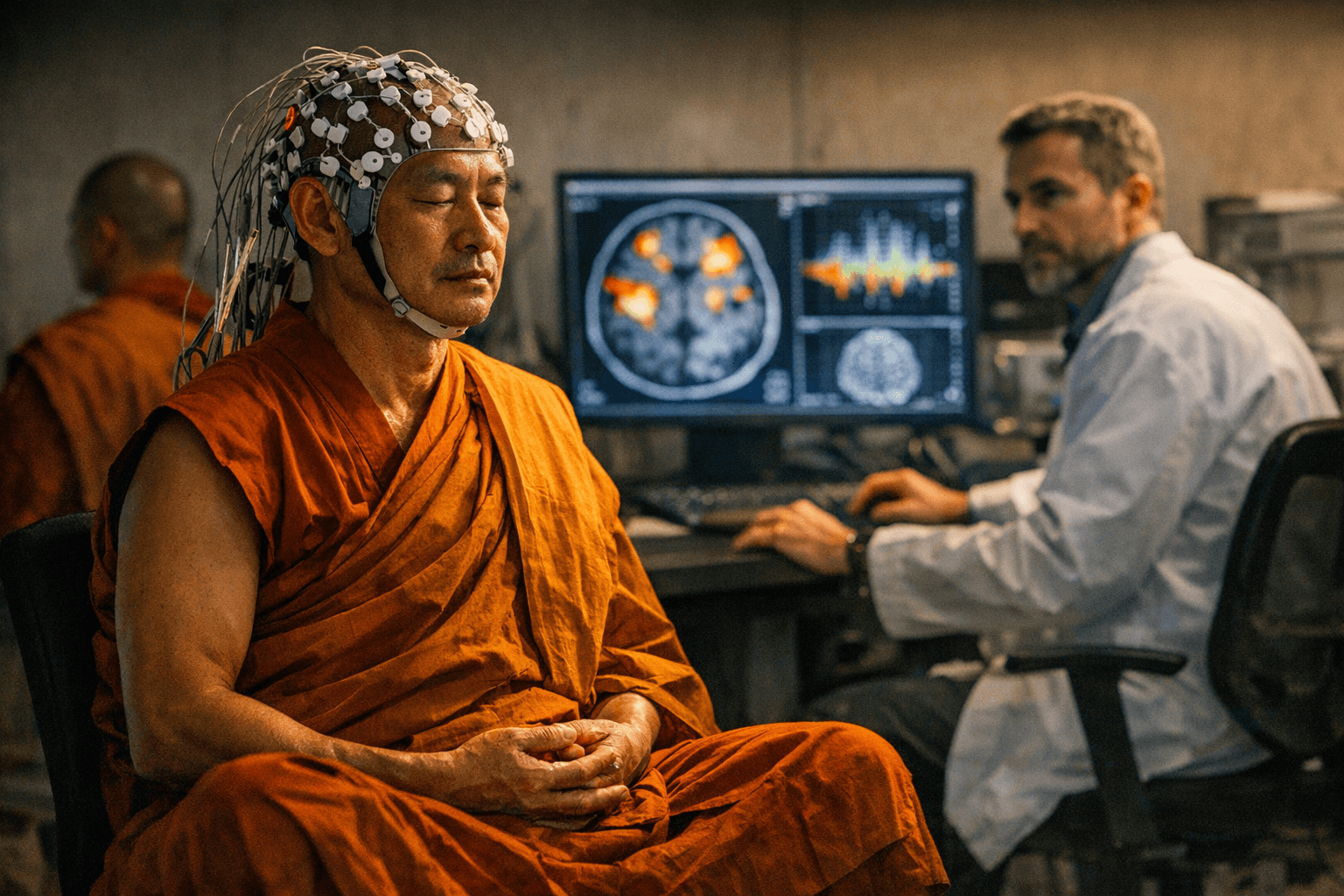
Twelve Buddhist monks from the Santacittarama monastery outside Rome just gave neuroscientists a rare look inside some of the most practiced meditating minds on earth, and what the scans revealed challenges a basic assumption many people hold about what meditation actually does to the brain.
The study, published in Neuroscience of Consciousness, used magnetoencephalography (MEG) to measure the magnetic fields produced by neural activity while monks switched between two foundational practices: Samatha and Vipassana. Rather than showing a quieting of brain activity, the results suggest that meditation cultivated a more dynamically organized state, with brain signals becoming measurably more complex and less predictable during both practices compared to rest.
The monks were not casual practitioners. All male, aged 25 to 58, and belonging to the Thai Forest tradition, a branch of Theravada Buddhism grounded in the oldest Buddhist scriptures, they averaged more than 15,000 hours of practice each. Researchers from Canada and Italy recruited this group specifically because of that depth of experience.
The two techniques produced meaningfully different effects. Samatha, which centers attention on a specific object such as the breath to achieve equanimity, produced a focused, stable brain state suited to deep concentration. Vipassana, which involves observing sensations, emotions, and thoughts as they arise without selective judgment, moved the monks' brain dynamics closer to what physicists and neuroscientists call criticality. "At the critical point, neural networks are stable enough to transmit information reliably, yet flexible enough to adjust quickly to new situations," says Jerbi, one of the study's researchers. ScienceAlert described this as a "sweet spot" of efficiency where the brain becomes optimally attentive and adaptable.
The research team also separated rhythmic brain waves from background neural activity, a methodological distinction that complicated decades of prior findings. Some earlier studies had reported increases in high-frequency gamma waves during advanced meditation. Here, once the signals were properly separated, adjusted gamma power actually decreased during meditation, with those drops concentrated in the frontal and parietal lobes, regions involved in attention and physical movement. The researchers interpreted this as the brain shifting away from processing external distractions and toward a state of integrated awareness. Strong effects also appeared in the default mode network, the system normally active during mind-wandering, which may explain how experienced meditators quiet internal chatter and sustain focus.
One of the more striking within-group findings: the most experienced monks showed the smallest difference between their meditative and resting brain states, suggesting their baseline resting brain has come to resemble the meditative state itself.
The study did not attempt to evaluate spiritual attainment, and the authors are careful not to overstate generalizability. Twelve monks from a single monastery in one lineage is a highly unusual sample, and any comparison to the general population has to account for lifestyle factors like isolation and religious practice alongside hours of formal meditation. ScienceAlert also noted that other research has documented a darker side to intensive practice, with some meditators reporting anxiety, depression, delusions, and a pervasive sense of fear, effects that may be underreported across the literature.
Still, the core empirical finding holds: when researchers used machine learning and advanced signal analysis to examine these monks' brains, they found not rest but reorganization, a more flexible, complex neural state that adapts rather than quiets.
Know something we missed? Have a correction or additional information?
Submit a Tip