Elite Athletes Like Biles and Liu Use Mindfulness to Perform Under Pressure
Simone Biles' Tokyo withdrawal wasn't a failure — it was a masterclass in the mental skills that separate good athletes from great ones.
The twisties don't announce themselves politely. When the mental block hit Simone Biles at the Tokyo Olympics, she withdrew from five of six event finals — a decision that stunned commentators and casual fans alike. As ScienceNews described it, the block was "petrifying": one wrong move on the uneven bars or a failed flip on the balance beam could cause a devastating injury, or even death. What looked to outsiders like a crisis was, to sports psychologists, a textbook demonstration of why psychological resilience has become just as essential as physical training at the elite level.
Biles and figure skater Alysa Liu represent a generation of elite performers who are openly integrating presence practices into their competitive toolkit. The mental side of sport, long treated as secondary to physical conditioning, has moved squarely to center stage.
When belief alone isn't enough
There's a useful illustration of psychological roadblocks in the TV show Ted Lasso: striker Dani Rojas suddenly can't nail his usually flawless penalty kicks, and a therapist is called in to deal with a case of the yips. It's fiction, but it captures something real. Belief, confidence, years of training — none of it automatically inoculates an athlete against the mental speed bumps that arise under competition pressure. The question researchers and practitioners are now seriously asking is: what actually works when those blocks hit?
Carolina Lundqvist, a sports and clinical psychologist at Linköping University in Sweden, has watched the field evolve rapidly. "There's also been an explosion of research into elite athletes' mental health in the last few years," she says, citing a 2020 analysis published in the International Review of Sport and Exercise Psychology. That explosion has narrowed the field to two especially promising psychological tools.
Mindfulness and ACT: the two tools getting serious research attention
The first is mindfulness, defined precisely as "paying attention to, or staying in, the present moment without judgment." That definition sounds deceptively simple. In practice, for an athlete who has just bobbled a routine play or missed a critical shot, staying non-judgmentally present rather than spiraling into self-criticism is a trainable skill, not an innate personality trait.
The second tool is Acceptance and Commitment Therapy, known as ACT. Used in conjunction with mindfulness, ACT "trains a person to accept difficult thoughts or feelings rather than actively work to get rid of them." This is a subtle but important distinction from older mental performance approaches that focused on suppression or replacement of negative thoughts. ACT doesn't ask you to pretend the anxiety isn't there; it asks you to stop fighting it and redirect your energy toward action that aligns with your values.
Studies have shown that these tools can improve athletic performance and, critically, lead to a richer life off the ice or the court. The research base is still growing — specific effect sizes and large-scale RCTs are areas where follow-up work is needed — but the directional evidence is consistent enough that teams and organizations are already implementing structured programs.
What a structured mindfulness program actually looks like
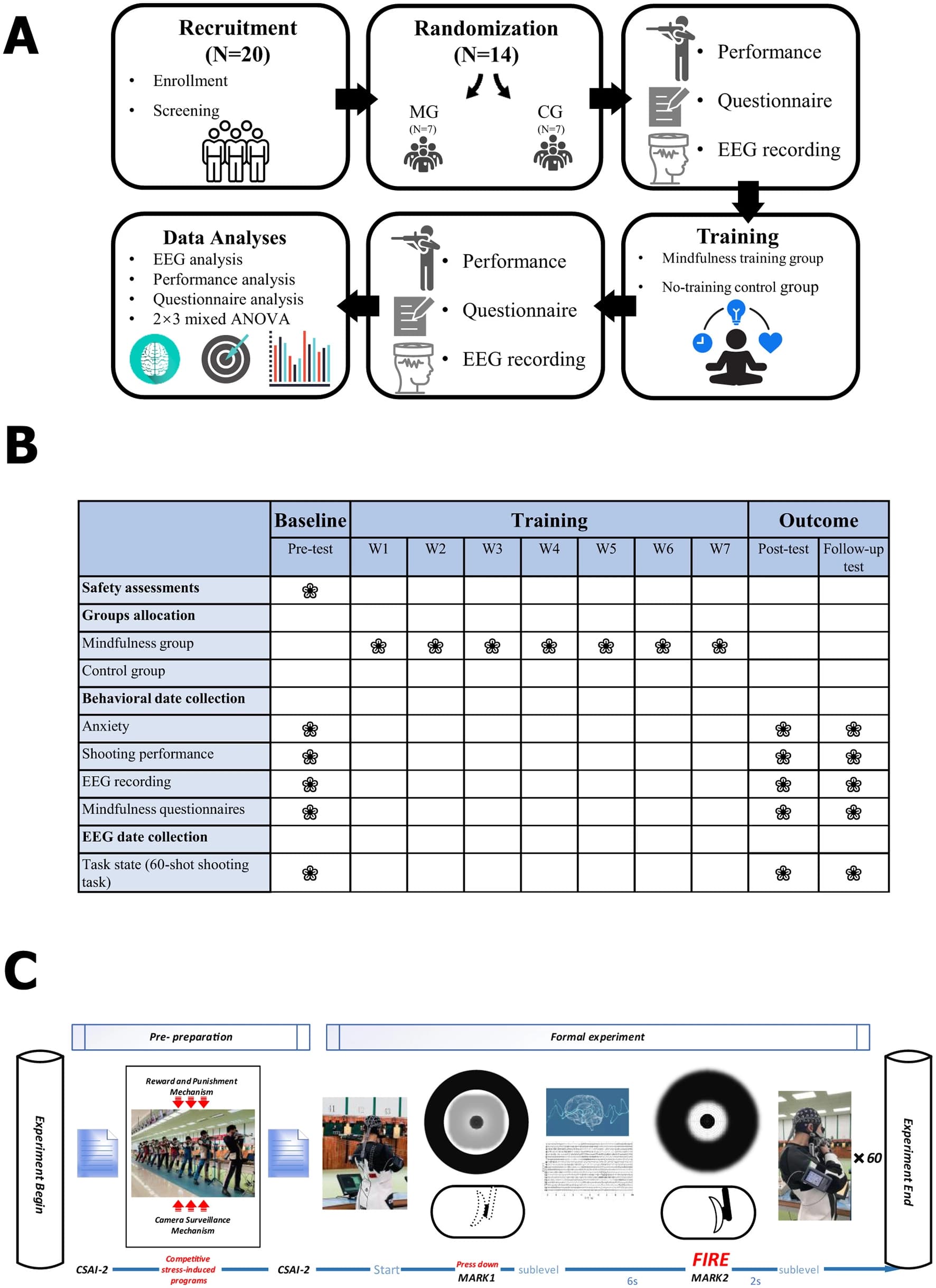
One documented program progression illustrates how these concepts translate into practical training. Sessions started with stationary meditations focusing on breathing and self-compassion, then progressed to mindful yoga and walking, and finally to throwing and catching exercises. That sequencing matters: you're building a skill under low-demand conditions before asking athletes to apply it in movement-based, sport-specific contexts.
Alongside the meditative work, players participated in group discussions about what they'd learned, specifically describing how they used the training to let go of mistakes. The coach reported that players became more focused on the second-to-second decisions of the game, rather than dwelling on something that had gone wrong. That shift — from retrospective rumination to present-moment decision-making — is exactly the mechanism mindfulness and ACT are designed to produce.
The east-west synthesis that underlies best practice
Not all mindfulness programs are created equal. Practitioners at Rutgers who draw on training in Zen meditation, mindfulness research, and neuropsychology argue that "the blend between the eastern and western principles produces the best practices." That blend involves four specific components:
- Recognizing thoughts as distorted and defusing from them
- Practicing mindfulness and meditation regularly
- Living consistently with one's values
- Fostering psychological flexibility
Psychological flexibility — the ability to remain open, adaptive, and oriented toward values-driven action even when uncomfortable emotions are present — is the through-line connecting all four. It's what allows an athlete to acknowledge "I'm terrified right now" and still execute.
The critical practical recommendation is about timing: "The key is not to prepare only during the Olympics. Rather, we practice this daily and integrate it into our regular training. This helps our brain become familiar with these practices and the mental skills become habits." Cramming mindfulness before a major competition the way you might review a playbook doesn't work. The neurological habituation requires consistent, repeated exposure over time.
Athletes reshaping the conversation
The industry of sport performance and mental skills training has grown immensely as athletes and their organizations look for every available edge. Part of what's accelerating that growth is the willingness of high-profile athletes to speak publicly about mental health struggles without framing them as weakness.
Biles' Tokyo withdrawal is the most dramatic recent example, but she's not alone. Michael Phelps, the most decorated Olympian in history, has been open about his mental health journey. Naomi Osaka, a four-time Grand Slam champion, has spoken candidly about anxiety and depression, including her decision to withdraw from press conferences and tournaments to protect her wellbeing. As a Rutgers analysis put it: "From Simone Biles... to Michael Phelps... and Naomi Osaka... elite athletes are reshaping how the world understands mental health in high-stakes competition."
The Olympic Games in particular place competitors under unparalleled global scrutiny. When the most gifted athletes in the world demonstrate that withdrawing to protect mental health is not only acceptable but strategically sound, it shifts what's considered possible for athletes at every level.
What this means for your own practice
If you're working with mindfulness as part of your own training or coaching, the evidence points toward a few non-negotiable principles. Daily practice isn't optional — it's the mechanism by which these skills become automatic under pressure. The session structure matters: start with stillness, add movement, then apply the skill in a sport-specific context. And ACT's acceptance framework is worth sitting with seriously, because fighting difficult thoughts during competition is expensive; accepting them and refocusing costs far less cognitive energy.
Biles didn't just survive Tokyo. She came back to win four medals at the Paris Olympics, demonstrating exactly what sustainable mental performance looks like when the psychological tools are embedded deep enough to hold under the most extreme pressure sport can generate. That's the real story behind the headlines.
Know something we missed? Have a correction or additional information?
Submit a Tip