Gary Allen Reflects on 35 Years Teaching Mindfulness Inside Prison Walls
Gary Allen first walked into a Colorado prison in 1990 as a Naropa University grad student; 35 years later, his Mindfulness Peace Project is still mailing Dharma books into cells across three countries.
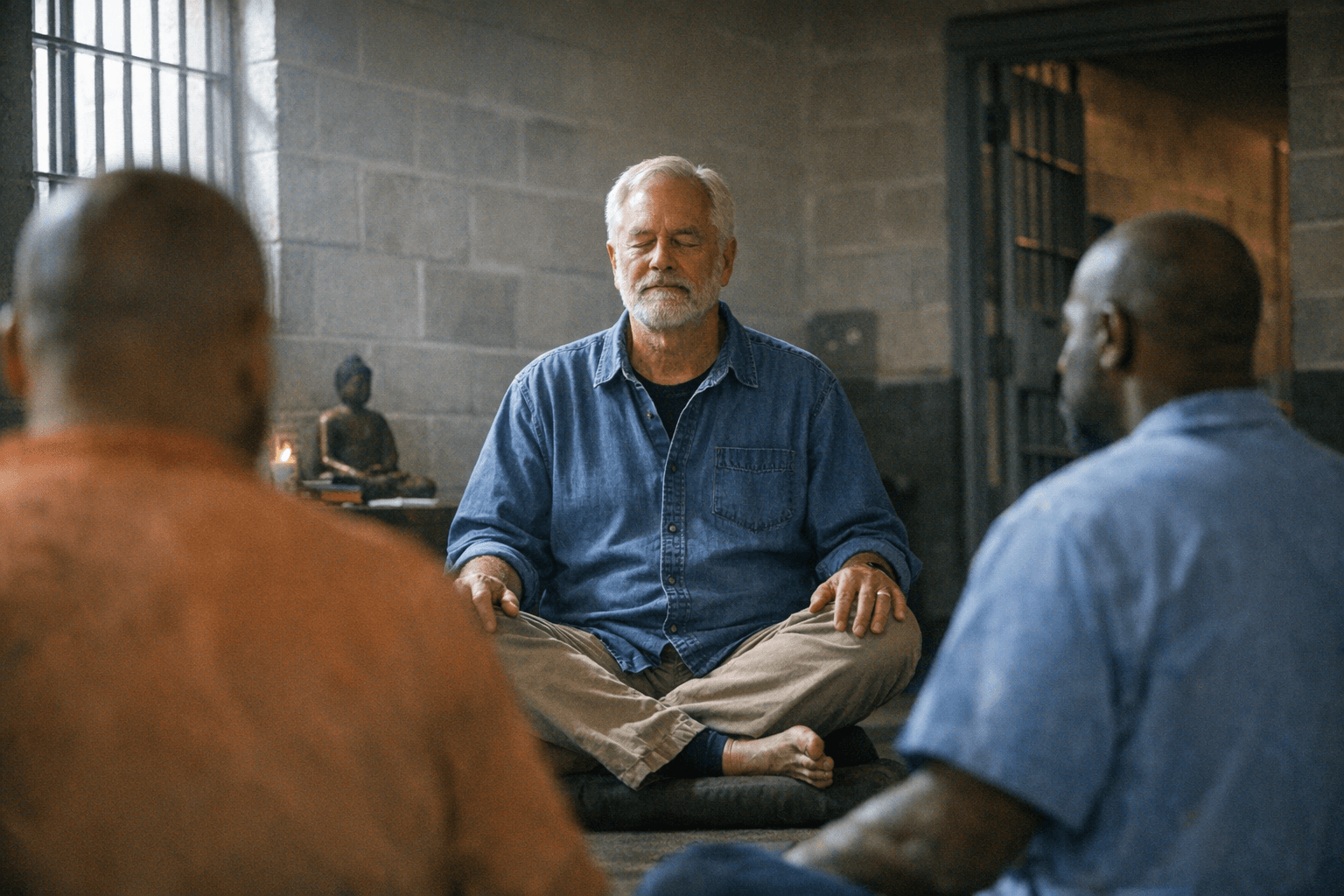
It started with a one-credit class. While completing graduate work in Writing and Poetics at Naropa University in 1990, Gary Allen joined a program that placed students in real-world settings to teach creative writing. He chose Territorial Correctional Facility in Canon City, the oldest prison in Colorado, with its massive cement walls still standing. Two days inside was enough to plant something that wouldn't let go. More than three decades later, Allen serves as co-executive director and director of education for the Mindfulness Peace Project (MPP), a Boulder, Colorado-based nonprofit that has quietly become one of the most sustained prison meditation programs in the country, with reach extending across the United States, Canada, and South Korea.
The profile his organization published in late March 2026 is not a press release. It reads more like a dispatch from someone who has been playing, in Allen's own words, "the long game."
What the Mindfulness Peace Project Actually Does
MPP operates through three interlocking programs, each designed to meet incarcerated people where institutional realities actually place them. The Ratna Peace Initiative (RPI) is the mail-based spine of the operation: Dharma books, magazines, and structured study courses go out by post to incarcerated people across the country and internationally. At any given time, Allen maintains personal correspondence with dozens of students, a one-to-one connection that most prison programming never achieves.
The second stream is direct, in-person group practice. Allen leads sitting groups in Colorado prisons, bringing secular meditation instruction, introductory chants including the Heart Sutra, and teachings drawn from multiple lineages including Nyingma, Kagyu, and Shambhala directly to participants on-site. The third pillar is Veterans Peace of Mind (VPoM), an evidence-informed program targeted specifically at incarcerated veterans, a cohort with a distinct set of needs shaped by military culture, moral injury, and trauma profiles that differ substantially from the general prison population.
How a Session Runs, and What Gets Taught
Allen's formal background runs deep. He trained with Tibetan Buddhist teacher Chogyam Trungpa Rinpoche and has studied Vajrayana Buddhism since 1978, accumulating 45 years of personal practice. His teaching inside prisons, however, is deliberately secular. The MPP approach uses focused breathing, body scanning, mindful listening, and sensory awareness practices framed in accessible, non-religious language, because institutional contexts vary and participant backgrounds are diverse.
A group sitting typically opens with brief chants invoking multiple lineages, moves into guided sitting instruction, and incorporates discussion of teachings on specific psychological challenges. Shantideva's classical teachings on patience and anger feature prominently, a curriculum choice that is anything but arbitrary: managing reactive anger is among the most practical and urgent skills for people navigating the daily stress, racial tribalism, and interpersonal volatility of prison life. Allen has noted that prisons are, fundamentally, not monasteries. They are loud, high-stress, and socially fractured environments that demand a different kind of teaching than any academic setting can prepare you for.
Discovering Sanity: Teaching People in Solitary
One of Allen's most significant contributions is a book written specifically for people in solitary confinement. *Discovering Sanity: Mindfulness Practice in Solitary Confinement* addresses the reality of living alone under fluorescent lighting for 23 hours a day, providing detailed instruction in sitting meditation, body scanning, walking meditation, and working with difficult emotions including anxiety, depression, hopelessness, and loneliness. A second edition, *Discovering Sanity: Mindfulness Practice in Prison*, adapts the same framework for general population. Both books are distributed in-house by MPP, mailed out regularly around the world, and accompanied by correspondence study courses.
For veterans, Allen authored *Warrior's Heart: Mindfulness Practice for Veterans*, a book that draws on input from veterans with meditation experience and addresses the specific socio-cultural imprint of military service, including PTS and anxiety-related disorders. Together, these three books form a curriculum that covers the major population segments MPP serves: those in solitary, those in general population, and those with military backgrounds.
The Barriers: Gatekeeping, Trauma, and Skepticism
Thirty-five years of access has not made the logistics easy. Institutional gatekeeping remains a consistent challenge: prisons regulate what can be mailed in, who can enter, and what programming receives approval. Mail-based delivery is partly a pragmatic workaround for facilities that restrict outside visitors entirely. Funding is a chronic pressure for a nonprofit operating at this scale without the institutional backing that larger behavioral health programs receive.
Inside the walls, the work itself carries specific risks. Mindfulness instruction in trauma-rich environments can activate rather than soothe: breathing exercises and body-focused practices can surface memories or physical sensations tied to violence, abuse, or loss. Allen's trauma-aware approach accounts for this directly, emphasizing safety and pacing, particularly with veteran cohorts where the risk of re-traumatization through poorly calibrated practice is clinically documented. Skepticism from corrections officers and administrators is another variable. Perceptions of Buddhist or contemplative practice as irrelevant, suspicious, or soft create institutional friction that must be navigated over years, not weeks.
The Ethical Debate: Rehabilitation or Pacification?
The broader prison mindfulness movement has attracted a critique worth taking seriously. Some scholars and advocates argue that teaching incarcerated people to manage their inner states more skillfully does not address the structural conditions that produce mass incarceration, and that framing the problem as one of individual emotional dysregulation can deflect attention from systemic failures. From this perspective, contemplative programs risk becoming a tool of institutional management rather than genuine liberation.
Proponents, Allen's work among them, argue the framing is a false choice. Emotional regulation, reduced reactivity, and the capacity to tolerate discomfort are not politically neutral skills but foundational capacities for navigating reentry, maintaining relationships, and making decisions under pressure. The question is not whether mindfulness addresses the causes of incarceration, which it does not, but whether it meaningfully improves the conditions and prospects of people already inside. On that narrower question, the evidence is increasingly positive.
What 35 Years of the Long Game Looks Like
The broader research context gives Allen's qualitative account some quantitative scaffolding. A five-year study launched by the Prison Mindfulness Institute in 2011 tracked 50 men in Rhode Island participating in a mindfulness-based emotional intelligence curriculum, and preliminary findings pointed to improvements in emotional regulation and behavior. Research published in peer-reviewed journals has documented reductions in self-reported stress, anger, and anxiety following mindfulness-based interventions in prison settings, with participants and instructors both reporting meaningful gains. One figure that surfaces repeatedly in the literature: a 43.5% rate of recidivism measured 15 years post-release in a cohort that participated in meditation programming, compared against substantially higher baseline reentry rates in the general population.
Allen's operation does not have a published randomized controlled trial to its name. What it has is continuity. Starting from a two-day writing class at a Canon City prison in 1990, through five years in Korea and back again, through the steady accumulation of mailed books, personal letters, group sittings, and study courses, the Mindfulness Peace Project has built something that institutional funders and formal researchers are only beginning to learn how to measure. The most honest assessment of that kind of work is probably the one Allen himself has long offered: it is a long game, and the points get counted slowly.
Know something we missed? Have a correction or additional information?
Submit a Tip