Margaret Cullen Explores Equanimity as the Practice Beyond Mindfulness
Cullen says you don't have to meditate to build equanimity, and her new book's second section proves it with practices that go well beyond the cushion.
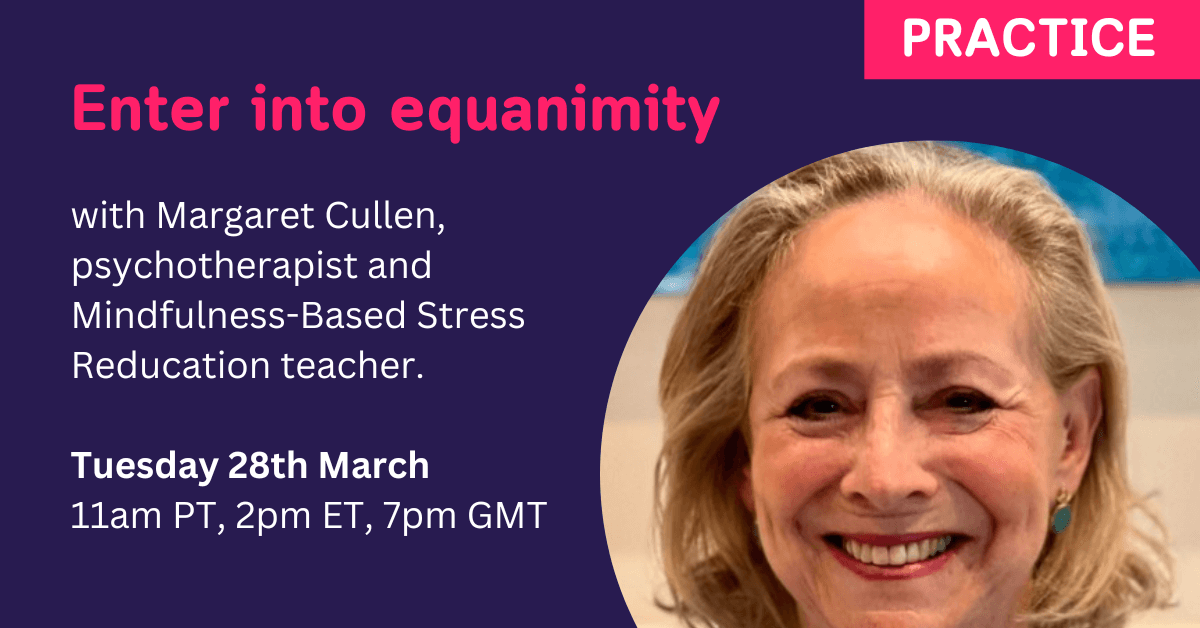
Margaret Cullen spent three years talking to neuroscientists, psychologists, faith leaders, meditation teachers, and at least one politician before she felt ready to write about equanimity. The result, Quiet Strength: Find Peace, Feel Alive, and Love Boundlessly through the Power of Equanimity, arrived in March 2026, timed alongside a feature conversation on Mindful.org that pressed Cullen on a question practitioners rarely hear asked directly: what is the actual difference between mindfulness and equanimity, and why does that difference matter?
Cullen's answer cuts against the assumption that equanimity is simply a deeper shade of mindfulness. She frames it as something more structural, "an internal strength of mind and heart characterized by non-reactivity and clear seeing," a quality that lets you meet fear, anger, or despair without being hijacked by them. In her own words from the book, equanimity "is our capacity to be tender-hearted without sentimentality, vulnerable without weakness, wise without detachment, humble without diffidence, and to surrender without passivity." That last phrase does a lot of work: this is not disengagement dressed up in spiritual language.
The most practically disruptive thing Cullen says is also the simplest. After roughly 15 years teaching mindfulness programs and another 15 working in the compassion space, she argues that equanimity doesn't require formal sitting practice at all. "You really don't have to meditate," she said in a recent interview. "Meditation is one way to cultivate equanimity. There are lots of other ways. And I have them in the second section of Quiet Strength, all sorts of ways." For a community that has organized much of its accessible entry points around breath-based and body-scan practices, that claim is worth sitting with.
Her framing of contemplative practice as training "the heart and mind as one integrated system" also shifts the conversation away from purely cognitive models of mindfulness. The practical payoff she emphasizes is speed of recovery: equanimity doesn't prevent you from getting knocked sideways by a difficult emotion, but it shortens the time you spend there. She ties this explicitly to nervous-system regulation and to what she calls the cultural pressure to prove you care by being constantly devastated, the 24-hour news cycle dynamic where outrage has become a performance of moral seriousness.

There is a cognitive dimension here that meditators who have done any work with noting practices will recognize. When you are fully gripped by an emotion, Cullen points out, you perceive only the evidence that confirms it. The awareness of that narrowing, she argues, is itself a lever: knowing your emotional state is filtering your view of reality can interrupt the confirmation loop before it tightens further.
Cullen's research credentials add weight to these claims. She is a coauthor on a 2021 Journal of Educational Psychology study examining how mindfulness training affected middle school teachers in their most stressful classrooms, and on a 2020 study in the journal Mindfulness linking mindfulness-based programs to teachers' forgiveness. Her earlier work includes the Mindfulness-Based Emotional Balance Workbook, coauthored with Gonzalo Brito and published by New Harbinger in 2015, as well as essays written alongside Paul Ekman and the Dalai Lama.
The Mindful.org conversation, published March 9, 2026, focuses on what equanimity looks like in teaching contexts and personal practice. More information on Cullen's work, upcoming live events, and her publications is available at margaretcullen.com.
This article was produced by Prism’s automated news system from verified source data, official records, and press releases, then run through automated quality and moderation checks before publishing. The system is built and supervised by the people who set the standards it runs under. Read our full AI policy.
Did this article answer your question?