Mindful Parenting Boosts Children's Educational Involvement in Rural China
Mindful parenting outpredicted household income tenfold as a driver of educational involvement in a study of 1,284 rural Chinese parents of preschoolers.
Tongyao Wang and Hongyan Cheng, writing in the journal Mindfulness on March 30, 2026, set out to challenge a comfortable assumption in family education research: that structural poverty is the dominant ceiling on how much parents can invest in their children's learning. Their mixed-methods paper, "The Role of Mindful Parenting in Shaping Parental Involvement in Rural China," found something that should give pause to program designers and practitioners alike. Parental characteristics, with mindful parenting as the strongest single factor, accounted for 34.9% of the variance in educational involvement. Household socioeconomic context and social factors together explained just 3.4%.
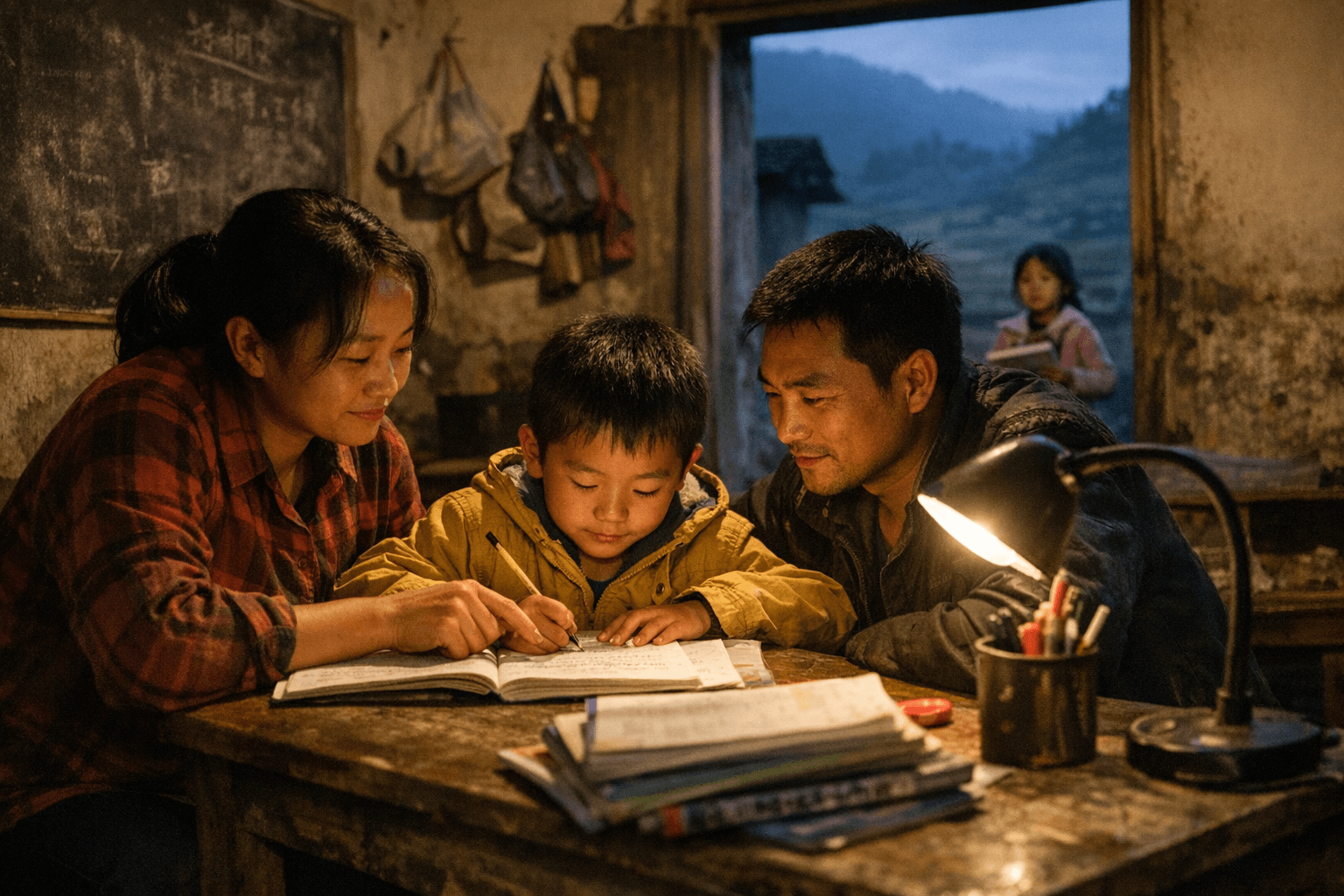
The study surveyed 1,284 parents of preschool-aged children in rural China and was built on Belsky's parenting process model, using an explanatory sequential design: a large-scale quantitative survey first, followed by qualitative interviews to expose the mechanisms behind the numbers. The qualitative phase included semi-structured conversations with parents of kindergarten-age children in Xiantao County, documenting how dispositional mindfulness actually shows up at the kitchen table, in homework routines, and in exchanges with preschool teachers.
What the qualitative data revealed was specific enough to be actionable. Mindful parenting did not manifest as formal meditation practice. It appeared as deliberate educational scaffolding at home, calmer and more persistent communication with teachers, and a capacity to keep trying despite the constraints that define rural Chinese family life: financial pressure, time scarcity, and the disruption of family members migrating for work. Wang and Cheng describe mindful parenting as an intra-personal lever, enabling parents to convert limited resources into higher-quality involvement rather than simply accepting those limits as fixed. Child characteristics, including gender and age, explained only 2.5% of variance, and neither variable was a statistically significant predictor on its own.
The two mechanisms the authors found most explanatory were present-moment attentional focus and compassionate emotion regulation. Both have direct, transferable applications. The first practice: during home learning activities, offer full, undistracted attention for the duration. Not passive presence but active co-engagement, asking what the child notices, reflecting their observations without defaulting immediately to correction. Wang and Cheng's qualitative data connect this attentive scaffolding to meaningfully higher involvement scores, independent of what parents could afford or access.
The second practice draws on the emotion regulation finding. Before any communication with a teacher, particularly one involving a concern or difficulty, pause and regulate first. The calmer, more persistent communication patterns the researchers documented were not incidental; they were tied to parents' capacity to approach these conversations without defensive reactivity pulling them off course.
The caveat matters and the authors state it plainly. Mindful parenting is not a substitute for material supports; it functions alongside them. Xiantao County is not suburban Melbourne or rural Vermont. The specific structural pressures Wang and Cheng studied, including migrant labor patterns, intergenerational co-parenting, and acute resource scarcity, create a context where the intra-personal lever finding is both more striking and potentially less portable. In settings where baseline material barriers differ, the relative weight of mindful parenting in predicting involvement may shift. The authors call explicitly for implementation studies testing scalable training models fitted to rural conditions. The mechanism is real; lifting the prescription wholesale without reading that fine print would miss the point of why they ran this study at all.
This article was produced by Prism’s automated news system from verified source data, official records, and press releases, then run through automated quality and moderation checks before publishing. The system is built and supervised by the people who set the standards it runs under. Read our full AI policy.
Did this article answer your question?