Mindfulness boosts exercise adherence and reduces stress in young adults
Mindfulness did more than lower stress here. In young adults, it helped exercise stick and may support better body composition inside a weight program.
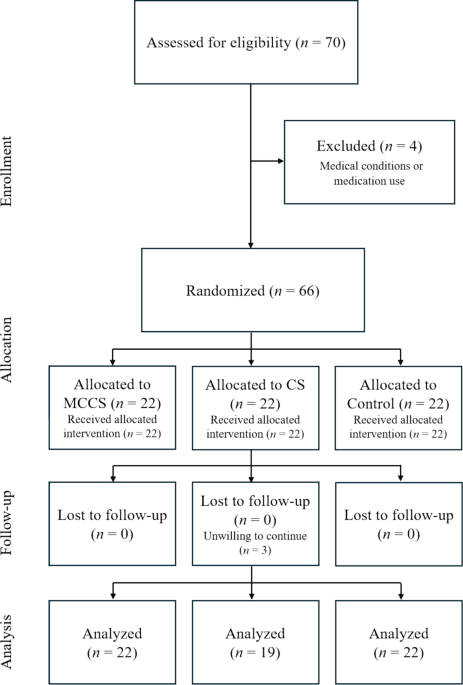
The real test in this paper is not whether mindfulness feels good, but whether it makes exercise-based weight management work better than exercise by itself. In a young-adult trial published in *Mindfulness* on June 22, 2026, adding an eight-week mindfulness component to a weight-management program improved exercise adherence, reduced stress, and pointed body composition in a better direction.
What the program actually tested
This was not a mindfulness-only experiment dressed up as a weight-loss story. The researchers built mindfulness into a broader program that also included education and exercise, then randomly assigned participants to a control group, a core stabilization group, or a mindfulness plus core stabilization group. The participants were young adults with overweight or obesity, with a mean age of 20.00 ± 1.12 years and a mean body mass index of 30.53 ± 6.37 kg/m2.
That setup matters because it matches the way people actually try to change behavior in the real world. Most people are not choosing between “mindfulness” and “nothing.” They are choosing whether a lifestyle program gets the extra tool that helps them keep showing up, especially when workouts get boring, stressful, or easy to skip. The study’s design asked that question directly instead of treating mindfulness as a stand-alone fix.
What changed when mindfulness was added
The cleanest wins were behavioral. Integrating mindfulness significantly improved exercise adherence, with the study reporting a 24.43 percent increase, and it also increased self-reported satisfaction with health behavior by 35.45 percent. Stress moved the other way, falling by 25.23 percent, which is the kind of shift that can change whether a person sticks with a plan after the first few difficult weeks.
The researchers did not stop at weight or stress questionnaires. They tracked unhealthy dietary patterns, physical activity enjoyment, sedentary behavior, sleep quality, mental health symptoms, satisfaction with health behavior, fitness measures, and body composition. That wider lens is useful because it shows where mindfulness appears to do its best work: not as a magical calorie burner, but as a behavioral amplifier that helps people regulate themselves more consistently.
Why the body-composition angle matters
The authors also suggest that weaving mindfulness into a weight-management program may promote more sustained improvements in body composition. That is a cautious claim, and it should stay cautious, but it is still important because many lifestyle programs get people started without helping them hold onto gains long enough for the scale and body-composition measures to shift in a durable way. In this trial, all groups improved cardiovascular fitness, muscle strength, and balance, which means the mindfulness advantage was not about exercise working only for one arm. It was about mindfulness improving the quality of the effort and the odds that the effort continued.

Where this fits in the bigger obesity picture
The public-health backdrop is hard to miss. The World Health Organization says that in 2022, 2.5 billion adults were overweight and 890 million were living with obesity, and adult obesity has more than doubled since 1990. The WHO also notes that more people are obese than underweight in every region except the South-East Asia Region. In the United States, the CDC’s 2024 adult obesity maps say obesity remains high and specifically flag early prevention among children and young adults as important for improving health and reducing health care costs.
That makes the age group in this trial especially relevant. An average participant age of 20 puts the study right at the point where habits are still forming, schedules are unstable, and exercise adherence can fall apart fast. The intervention is not a cure-all, but it is a practical attempt to add friction against dropout at the exact life stage when that dropout risk is high.
What the broader evidence already suggested
This trial also fits a long-running pattern in the literature. An Obesity Reviews review noted that mindfulness and mindful eating have gained attention because of their promise for eating behaviors and weight loss. A 2023 systematic review and meta-analysis found that the effects of mindfulness-based interventions on BMI, waist circumference, weight, and percent body fat are still an active area of study, which is a polite way of saying the field has signals, but not a settled final answer.
There is also precedent for using mindfulness as an add-on rather than a replacement. A randomized clinical trial in adults with obesity enrolled 194 participants and tested mindfulness-based eating and stress management inside a diet-exercise program. That older design is the same basic logic seen here: pair mindfulness with standard behavior change tools, then see whether the extra layer improves the parts that usually break down first, especially adherence and stress handling.
The practical takeaway
The sharpest lesson from this young-adult trial is simple: if you already have exercise and education in place, mindfulness may help people actually use them. The clearest gains were not vague calm or general wellness, but better exercise adherence, lower stress, and higher satisfaction with the health behavior itself, which is exactly the combination that keeps a program alive long enough to matter. For anyone building or joining a weight-management plan, the most useful version is the one that treats mindfulness as the part that helps you keep turning up, not the part that replaces the workout.
This article was produced by Prism’s automated news system from verified source data, official records, and press releases, then run through automated quality and moderation checks before publishing. The system is built and supervised by the people who set the standards it runs under. Read our full AI policy.
Know something we missed? Have a correction or additional information?
Submit a Tip