Mindfulness Meditation Study Links Regular Practice to Measurable Health Improvements
A 10-day mindfulness program via the Oura app improved sleep efficiency and raised heart-rate variability in 81 healthy adults, with most gains holding at a 4-week follow-up.
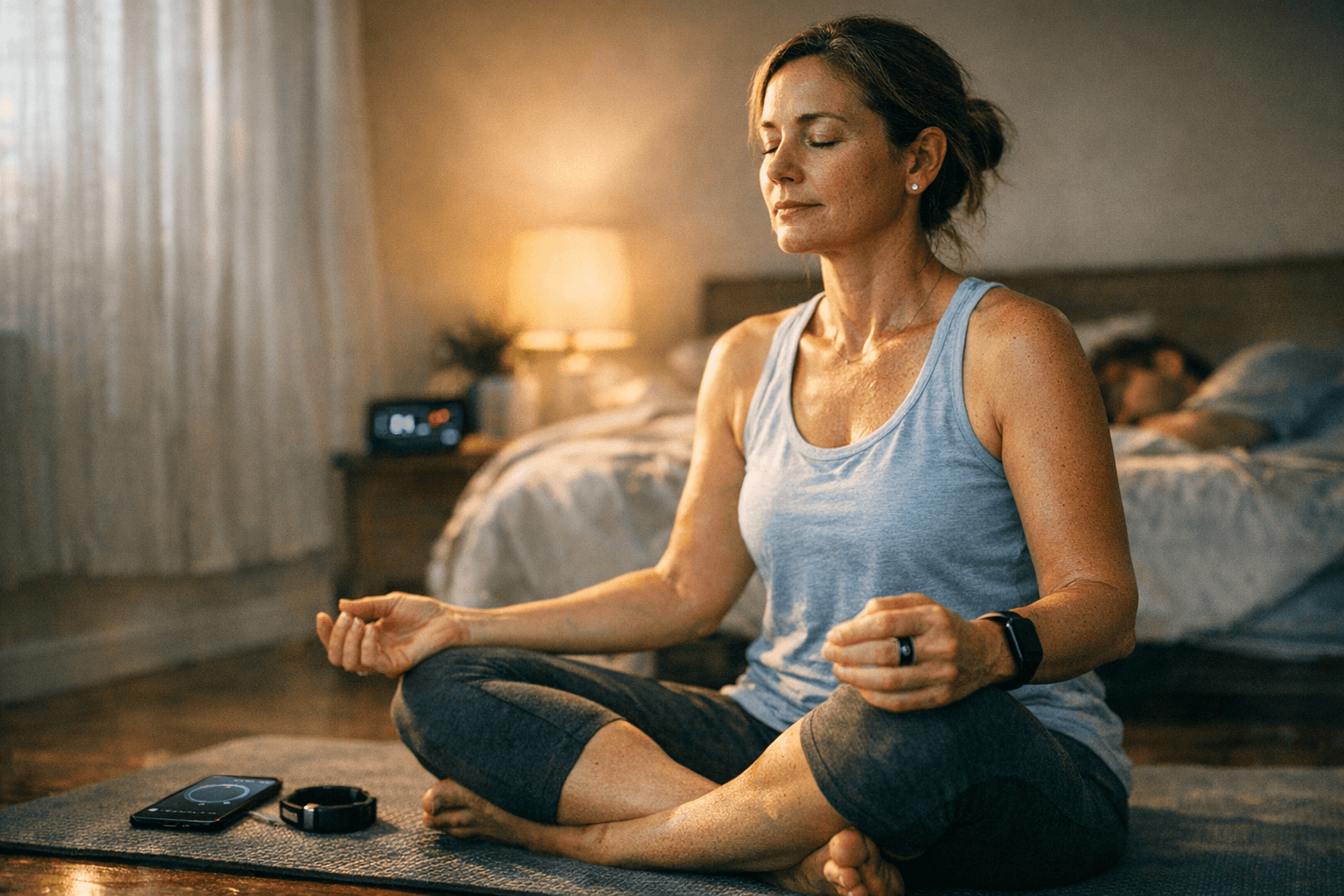
Ten days of app-based mindfulness practice was enough to produce measurable physiological change, according to a randomized trial in which 81 healthy adults were assigned to either a mindfulness program or a waitlist control through the Oura app. The findings, from Ulrich Kirk and colleagues at the University of Southern Denmark, put hard numbers behind something practitioners have long reported anecdotally: a consistent sitting practice changes your body, not just your mind.
Participants wore an Oura ring throughout baseline, the intervention period, and a 4-week follow-up, continuously recording sleep efficiency, total sleep, deep and light sleep, and sleep-onset time. That design matters. Device-measured outcomes remove the self-report bias that plagues so much wellness research, where people who feel good about meditating also tend to report sleeping better.
Mixed-model ANOVAs revealed significant group-by-time interactions for sleep efficiency, total sleep, deep and light sleep, and sleep-onset time, with all p-values below 0.031. The mindfulness group improved across all those measures after 10 days, and the gains held at the 4-week follow-up, with the exception of deep sleep.
During the actual mindfulness sessions, heart rate fell and heart-rate variability rose, both reaching statistical significance. HRV is the metric that the biohacking and contemplative communities have increasingly converged on as a proxy for autonomic nervous system health, and seeing it shift during sessions, tracked continuously by a wearable rather than in a clinic, adds real-world credibility to the finding.
Participants also completed validated self-report tools including the Pittsburgh Sleep Quality Index, the Perceived Stress Scale, the Copenhagen Burnout Inventory, and the Mindful Attention Awareness Scale, collected before and after the intervention and again at follow-up.
One nuance worth noting: the mindfulness group showed a transient increase in personal burnout scores immediately post-intervention, though those returned toward baseline by follow-up. The group also showed higher scores on the Mindful Attention Awareness Scale, suggesting the program did shift attentional awareness as intended.
Kirk led the study from the Department of Psychology at the University of Southern Denmark in Odense, with co-authors Cirkeline Nellemann Hovgaard, Marino Theodor Larsen Persiani, and Walter Staiano, and with collaborators from the Fralin Biomedical Research Institute at Virginia Tech and the Department of Physical Education and Sport at the University of Valencia. The paper was accepted March 16, 2026, and published in Scientific Reports five days later.
For anyone already tracking HRV or wearing a ring to bed, this trial is a direct argument for consistency over duration. Ten days, a single app, a consumer-grade wearable, and the signal was strong enough to persist a month later. That's not nothing.
This article was produced by Prism’s automated news system from verified source data, official records, and press releases, then run through automated quality and moderation checks before publishing. The system is built and supervised by the people who set the standards it runs under. Read our full AI policy.
Did this article answer your question?