Study tests whether mindfulness adds to compassion training for college students
A 72-student trial strips mindfulness out of compassion training to see whether the meditation piece actually changes the program's effects.
The real question here is not whether compassion training helps. It is whether mindfulness is the ingredient that changes the recipe.
That is what makes this study worth reading closely. Instead of treating compassion work and mindfulness as one blended package, it separates them and compares three groups of Chinese college students: Compassionate Mind Training, the same program without mindfulness, and a wait-list control. When a study is built this way, it stops being a general feel-good story and becomes a test of what the mindfulness layer is actually doing.
What the trial set out to isolate
The researchers used a component-analysis approach over an 8-week intervention period, which is exactly the right tool for a question like this. If compassion training includes self-kindness, soothing imagery, and emotion regulation, does mindfulness add something distinct, or is it just the familiar meditation wrapper around the same basic skills?
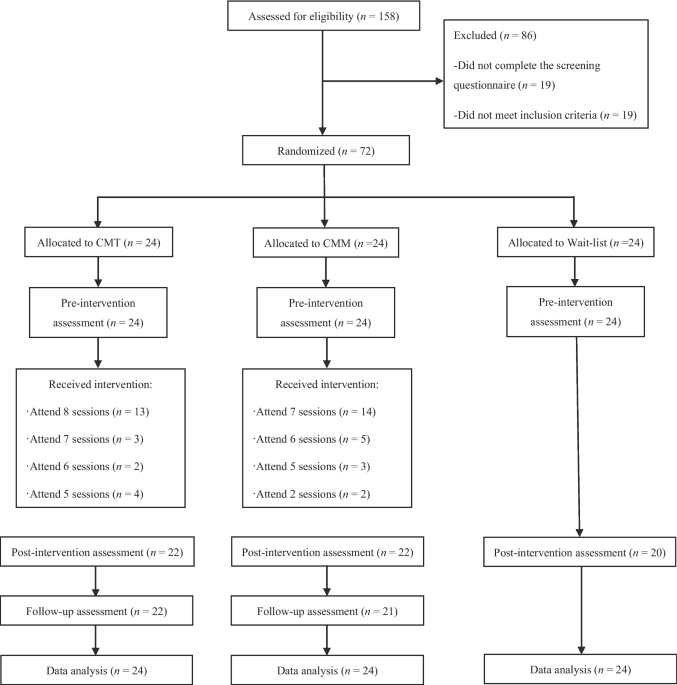
The design is unusually clean. Seventy-two college students were randomly assigned, with 24 participants in each group. All participants completed self-report questionnaires before the intervention, after the 8 weeks ended, and again at 6-month follow-up. That matters because it gives the study a chance to look beyond the immediate post-course glow and see whether any effects hold up after the semester rhythm has moved on.
For a college population, that kind of setup is especially useful. Students need programs that are brief, structured, and realistic around coursework, exams, and social stress. If a compassion-based program works just as well without mindfulness, that has obvious implications for campus delivery and for digital mental-health tools that need to stay lightweight. If mindfulness does add a unique effect, then the meditation piece deserves to stay in the package.
Why compassion training keeps showing up in mindfulness circles
Compassionate Mind Training, often shortened to CMT, did not start as a campus tool. Stanford Medicine’s INSPIRE Training Program notes that it was originally developed for psychotherapy, then later adapted for the general public and used with students, teachers, healthcare staff, and other groups. Stanford also notes that Dr. Chris Irons and Dr. Charlie Heriot-Maitland developed and ran the first 8-week public CMT course in 2015.
That history helps explain why CMT is now showing up in studies like this one. It is already a flexible framework, built to train people in compassion skills rather than just mood management. In practice, that makes it a good candidate for component testing, because it can be split apart and examined without losing its identity.
The broader compassion-focused tradition, associated with Paul Gilbert, has also built enough momentum that researchers are no longer asking only whether the approach works. They are asking which pieces matter most. That shift is important. Once a method becomes popular, the next step is not more vague praise. It is figuring out what is essential, what is optional, and what can be simplified without weakening the outcome.

What the broader evidence suggests so far
This study sits inside a larger wave of research that is trying to sort out the active ingredients in meditation and compassion programs. A 2023 systematic review of compassion-focused therapy in clinical populations found promising effects on compassion-based outcomes and symptom reduction. That does not settle every question, but it does support the basic idea that compassion-centered approaches can move the needle.
On the mindfulness side, a 2025 systematic review and meta-analysis of school-based mindfulness trials found small but statistically significant effects on depression, mindfulness, emotion regulation, and perceived stress. Anxiety was less convincing after correction for multiple comparisons. That is a useful reminder that mindfulness is not a magic switch. It can help in some domains more reliably than in others.
The college-student setting matters here too. A 2024 randomized study in mainland China looked at 64 college students with test anxiety and tested a 6-week program that combined CMT with cognitive behavioral therapy. The results showed reduced test anxiety, better self-compassion, stronger perceived ability to manage negative emotions, and lower general anxiety, with benefits still present at follow-up. That gives the current study a practical backdrop: compassion-based programs are already being used in student populations, and researchers want to know how much of the benefit depends on the mindfulness component.
Why the comparison matters for real campus programs
This is where the study becomes more than a methodological exercise. On a crowded campus, every extra session, every extra skill, and every extra minute of practice has to earn its keep. If mindfulness is doing unique work inside compassion training, then it belongs there as a core piece. If the compassion practices still carry most of the load without it, then a shorter or more targeted version may make more sense for some students.
That is especially relevant for implementation. A lighter version of the program could be easier to fit into counseling services, group workshops, and app-based mental-health support. A fuller version might still be the better choice when the goal is not just stress reduction but a deeper shift in how students relate to shame, self-criticism, and emotional difficulty.
The larger lesson is that mindfulness research is maturing. Scientists are moving past the question of whether a broad intervention sounds beneficial and into the tougher question of which ingredient actually matters. That is a healthier way to build programs, because it forces each part of the training to justify its place.
When the next student-friendly compassion program comes along, the most useful question will not be whether it includes mindfulness in name only. It will be whether that extra layer changes the outcome enough to be worth the time. This study is built to answer exactly that, and that is what makes the comparison so practical.
This article was produced by Prism’s automated news system from verified source data, official records, and press releases, then run through automated quality and moderation checks before publishing. The system is built and supervised by the people who set the standards it runs under. Read our full AI policy.
Did this article answer your question?