UC San Diego twin study finds meditation rapidly reshapes brain, blood, heart dynamics
A six-twin pilot study suggests a 7-day retreat can shift meditation effects beyond the individual, with brain, blood, and heart patterns converging and then separating in real time.
The twin setup is what makes this meditation study hit differently
If you have ever wondered whether a hard week of retreat practice does anything more than a good daily sit, this UC San Diego study gives the cleanest peek yet. Researchers followed six twin pairs, five identical and one fraternal, through a 7-day retreat and watched the same body-family split into similar, different, and then similar-again patterns across brain activity, blood biology, and heart dynamics.
That matters because twins strip away a lot of the usual noise. When two siblings start from nearly the same baseline, a shift that appears mid-retreat is harder to dismiss as simple personality, genetics, or random drift. In this pilot, the team saw twin sets look similar before the retreat, diverge in the middle, and then become more similar again by the end, which makes the retreat itself look like the main active ingredient.
What the retreat actually looked like
The setting was not a quiet solo cabin. The retreat took place in April 2022 at the Manchester Grand Hyatt Convention Center in San Diego and was led by Joe Dispenza. The study, published May 7, 2025 in *Mindfulness*, used a mixed battery of measurements that reads more like a mind-body lab than a wellness weekend: quantitative EEG, whole-blood transcriptomics, and metabolomic and biochemical analyses from blood plasma.
That mix is the point. Meditation studies often stop at one lane, maybe mood, maybe sleep, maybe a single biomarker. Here, the researchers tried to catch the retreat from several angles at once, looking for whether the nervous system, the blood, and the cardiovascular system were all moving together. The twin design gave them a built-in comparison that was unusual enough to stand out even in a field already used to ambitious retreat research.
Why the twin comparison is the headline result
The study’s most interesting signal was not just that the twins changed. It was that they changed in relation to one another. Twin pairs showed spectral power correlations even when they were separated into different rooms, and those correlations also showed up when only one twin meditated. Unmatched twin pairs did not show the same pattern.
That is the kind of result hobbyist meditators actually care about, because it hints that an intensive retreat may do more than temporarily relax you. It may reorganize the way a practiced mind and body coordinate under sustained exposure to meditation. The heart data pointed the same way: heart rate dynamics aligned among twin pairs, but not among unmatched pairs, which suggests the retreat amplified shared physiological timing rather than producing a generic “everyone feels calm” effect.
The brain, blood, and heart were all in the story
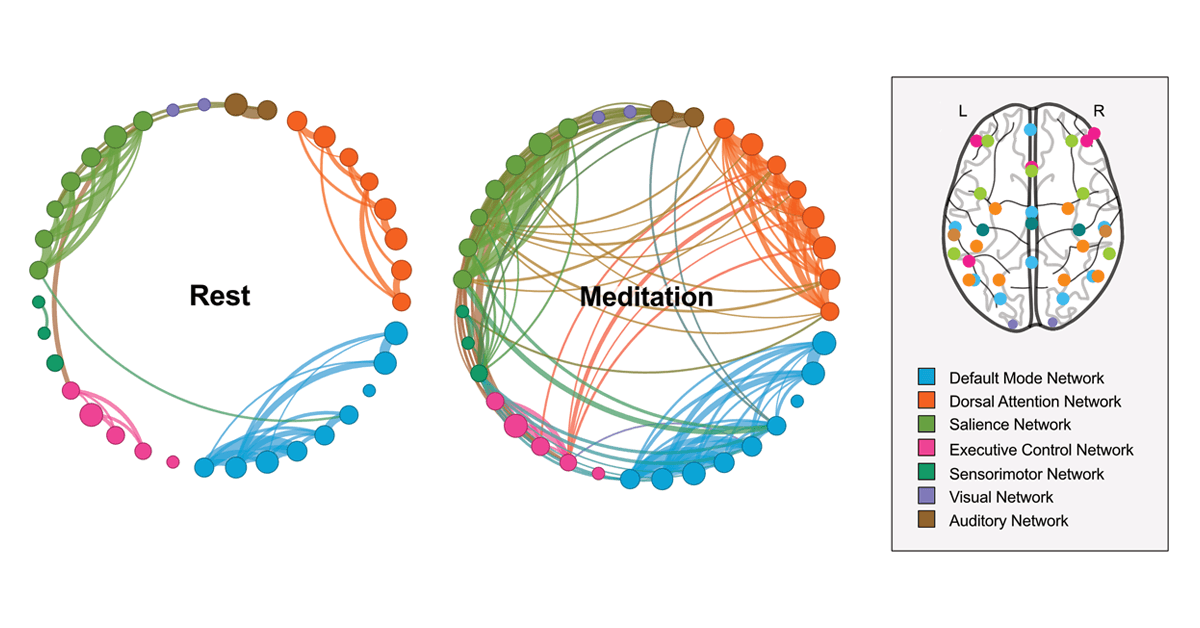
This was not just a brain paper with a nice headline. The team examined qEEG patterns, whole-blood transcriptomics, and blood-plasma chemistry together, then looked for the way those systems tracked across the week. The result was a picture of a retreat that seems to push coordination up and down in phases, with the strongest hint of change appearing mid-retreat before the twins settled back into more similar patterns by the end.
The companion UC San Diego report, published November 6, 2025, broadened that picture. In that related work, 20 healthy adults completed a 7-day residential program that included daily lectures, about 33 hours of guided meditation, and group healing practices using an open-label placebo approach. UC San Diego said that study found rapid changes in brain function and blood biology, including reduced connections in brain regions tied to “inner chatter” and synchronized activity across different brain areas.
Put simply, the retreat did not only look calming. It looked reorganizing.
What this means for people who already meditate
For anyone already doing daily practice, the useful question is not whether meditation is good in general. It is whether an intensive retreat can do something a normal routine cannot. These studies point to yes, at least in the short term: a retreat can create a measurable physiological shove, one strong enough to show up in brain rhythms, blood biology, and heart-rate alignment over just seven days.
That does not mean a retreat replaces daily practice. It means the retreat format may act like a laboratory for change, compressing the effect of many hours of meditation into a short window where it can be observed and measured. If your regular sits are maintenance, the retreat looks more like a reset button, or at least a serious systems check.
The broader UC San Diego meditation program gives this weight
This work sits inside a larger UC San Diego meditation effort backed by the InnerScience Research Fund. The fund pledged up to $10 million over five years in 2023 and added another $2.45 million in June 2025 to accelerate research on meditation’s biological effects. That kind of support helps explain why UC San Diego can keep moving from a single study toward a full program of mind-body measurement.
The university’s Center for Mindfulness also helps frame the practical side. Its evidence-based programs are rooted in Mindfulness-Based Stress Reduction and decades of research, which is the right reminder for readers who care less about spiritual branding and more about what actually holds up. This is not an argument that every retreat is magic. It is evidence that, under the right conditions, intensive practice can leave a detectable signature in the body.
What to take from the twin data
The cleanest takeaway is that the retreat effects were not evenly generic. The twins behaved like a living control layer: similar before the retreat, pulled apart during it, then drawn back into closer alignment by the end. That pattern, plus the room-separated EEG correlations and the matching heart dynamics, makes the case that intensive meditation can produce a coordinated, measurable shift rather than a vague wellness glow.
The practical lesson is straightforward. A 7-day retreat can be more than a spiritual immersion; it can be a physiological intervention with enough signal to show up in brain, blood, and heart readouts at once. For meditators who want to know what the retreat format is really buying, this study suggests the answer is not just quieter thoughts, but a whole-body change that can be tracked.
This article was produced by Prism’s automated news system from verified source data, official records, and press releases, then run through automated quality and moderation checks before publishing. The system is built and supervised by the people who set the standards it runs under. Read our full AI policy.
Did this article answer your question?