University of Queensland Trial Finds Wim Hof Method and Meditation Build Resilience Differently
A University of Queensland trial of 404 adults found the Wim Hof Method and mindfulness meditation each build resilience, but through completely different mechanisms over 29 days.

A semi-randomised controlled trial led by Dr. Jemma King of the University of Queensland's School of Psychology enrolled 404 healthy adults, averaging 37 years of age, to test whether the Wim Hof Method's intentional breathwork and cold exposure could outperform mindfulness meditation as a psychophysiological and cognitive training tool. The answer was not a clean victory for either practice. It was a map of two different destinations.
Dr. King entered what is being called the world's largest Wim Hof study with "a healthy dose of scientific skepticism," telling Fox News Digital: "People are really anxious, people are really burnt out, and the world is very destabilized at the moment." She added: "We're glued to screens; we're reaching for pills every time life feels hard. And so we really wanted to [find out] — is there a better way?"
Participants, comprising 226 females, 177 males, and 1 other, were assigned to one of three 29-day interventions: Wim Hof Method in-person, Wim Hof Method remote, or mindfulness meditation. The WHM practitioners were split into in-person and at-home groups, where one did ice baths and the other took cold showers. The meditation group completed 15-minute breath-focused guided sessions as an active control, matched structurally to the breathwork protocol to keep the comparison clean.
Participants were instructed to complete their daily study participation before starting their day, with daily study time ranging between 20 to 23 minutes and structured as: a pre-intervention survey, the intervention itself, a post-intervention survey, and an executive function task using either the Stroop or N-back test. In-person induction sessions were provided for the WHM condition, while online inductions were offered for both the WHM-remote and meditation groups, with certified Wim Hof Method and mindfulness instructors guiding participants through daily protocols and supplying all necessary resources. Condition-specific weekly online Q&A sessions with instructors and the research team were hosted to incentivise compliance and ensure accurate implementation.
Throughout the research period, every group felt better immediately after doing their daily practice, but the Wim Hof Method groups reported significantly greater boosts in energy, mental clarity, and ability to handle stress. The divergence became most apparent across the 29-day arc. For the mindfulness group, meditation initially lowered stress more right after a session, but the effects plateaued or even somewhat diminished over successive days, while the Wim Hof Method quickly surpassed the meditation group and ultimately showed the strongest immediate anxiety reductions.
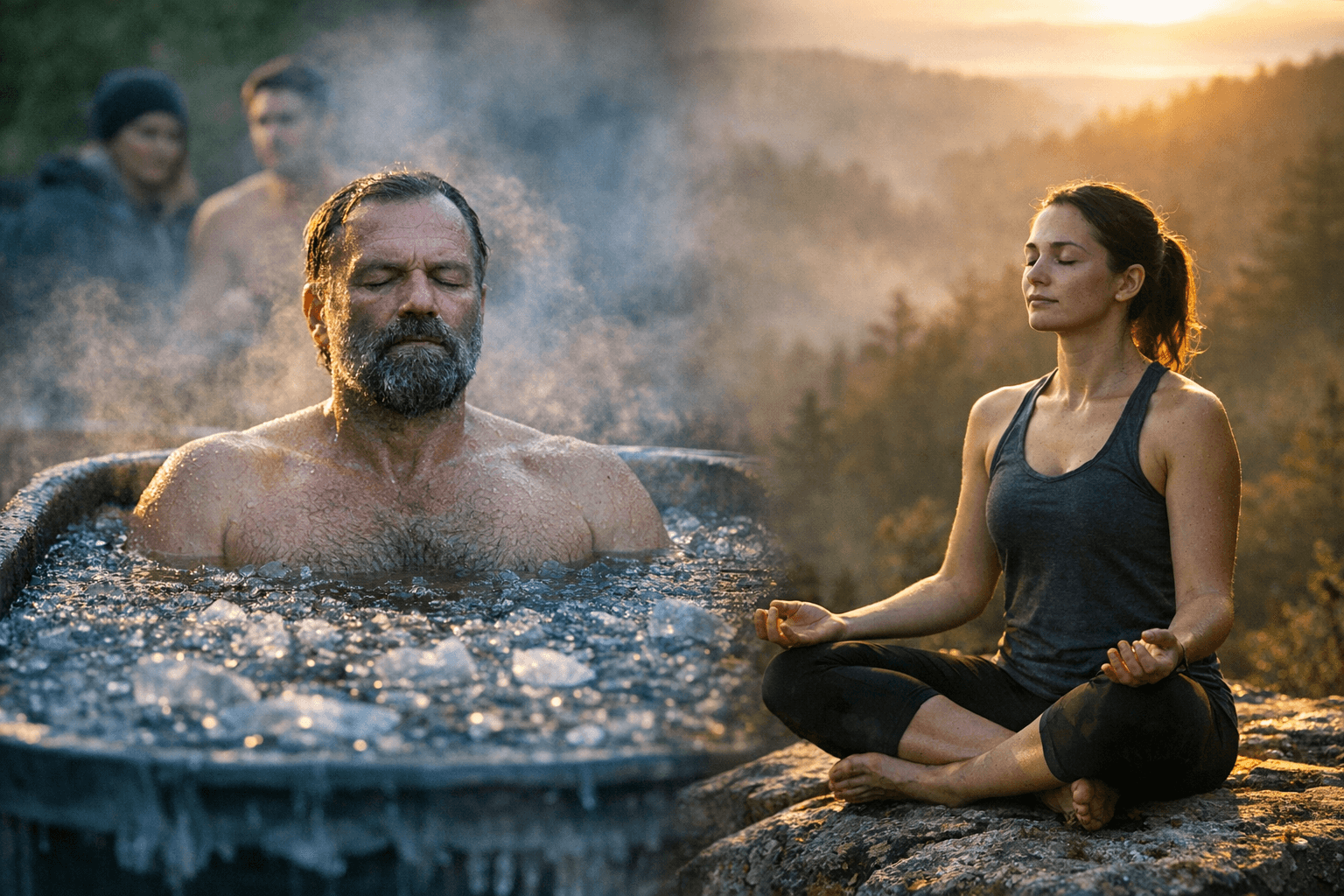
The physiological data reinforced that pattern. Baseline physiological changes were modest over the 29 days, but the study did find a day-by-day decrease in respiratory rate in the Wim Hof Method groups, indicating that with longer practice, persistent adaptations may occur. Meditation, by contrast, delivered measurable gains in sleep architecture and cognitive precision: it supported stronger calming effects, better sleep duration, lower anxiety, more accurate executive function performance, and steadier cognitive accuracy, according to analysis by the wellness outlet Superage.
The practical interpretation that emerges from the data is not "which practice wins" but "what each practice trains." Researchers found that each practice appears to train a different aspect of resilience. As Superage framed the findings: "Meditation reliably supports calming, sleep, and anxiety reduction. Wim Hof practices appear to train how capable, energized, and clearheaded people feel when stress is present, especially with repetition. These are different adaptations, not opposing ones."
One finding caught the research team off guard. Dr. King noted: "We also found something really shocking and unexpected: The people doing the Wim Hof Method became more willing to speak up at work. They were more likely to raise hard issues or have a voice or take interpersonal risks." She attributed this to the psychological transfer of daily cold exposure: "If you train yourself to step into the cold water every morning, you kind of override that voice that says, 'Don't do that.' This bravery, this toughness that you train every morning, starts to show up everywhere else in your life." The research notes describe this team psychological safety effect as exploratory and confirm it did not persist at the three-month follow-up.
The trial, titled "A semi-randomised control trial assessing psychophysiological effects of breathwork and cold immersion," was published in Scientific Reports. What it ultimately demonstrates is something many practitioners have long sensed: Wim Hof breathwork, cold showers, and ice baths have immediate positive effects, but those effects compound with consistent, repeated efforts — while meditation's power runs in a quieter, steadier current, reliably smoothing the nervous system for those willing to sit with the breath each morning.
This article was produced by Prism’s automated news system from verified source data, official records, and press releases, then run through automated quality and moderation checks before publishing. The system is built and supervised by the people who set the standards it runs under. Read our full AI policy.
Did this article answer your question?


