How long to knead sourdough dough, timing depends on method
Still tearing after 10 minutes? The clock is only the starting point. Sourdough tells you more through feel, elasticity, and the windowpane test, especially at higher hydration.
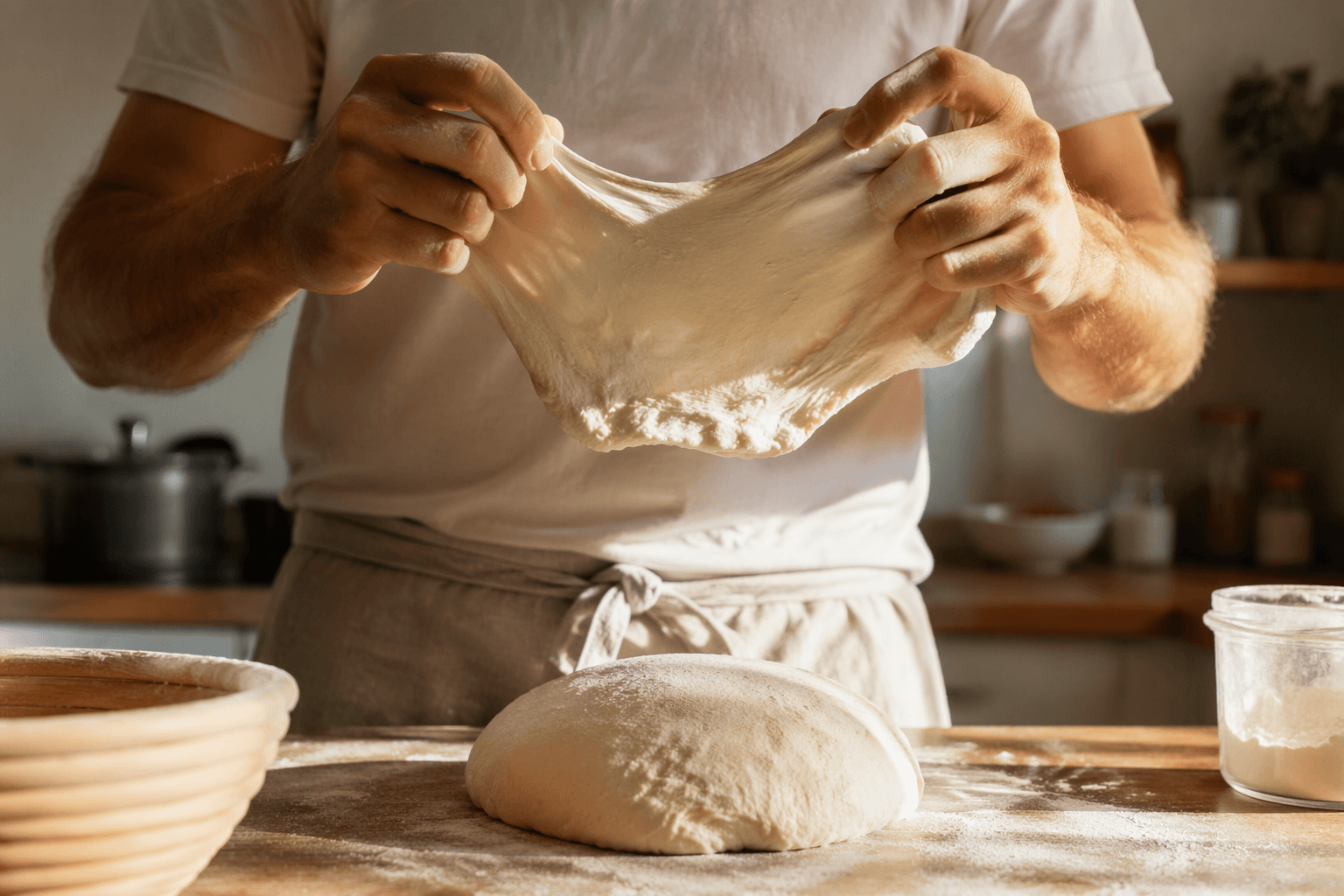
If a sourdough dough tears at the first tug, it usually needs more development or rest. Sourdough kneading is not a stopwatch contest. The dough may need more time, less speed, or a short rest before it starts behaving, and the answer changes with the method you use. In practice, the clock matters, but the dough’s feel matters more.
Start with what kneading is doing
Kneading builds the gluten network, the structure that helps trap gas and give the loaf lift. Think of it as the dough’s scaffolding: if it is weak, the loaf spreads and tears; if it is pushed too hard, the dough can get overheated or lose the texture you want.
A systematic review identified the variables that change dough behavior: kneading time, dough temperature, kneading speed, aeration, water temperature, and total water content. The same formula can behave very differently depending on the bowl, the room, and the machine.
What the dough should feel like when it is ready
Look for progression rather than perfection. Early on, a sourdough dough can be shaggy and sticky, especially if it is a higher-hydration mix, and that is not a reason to panic or dump in a pile of flour. As it develops, it should become smoother, more cohesive, and more elastic, with a soft, supple feel.
One useful tactile marker is the soft earlobe comparison: the dough should feel pliable rather than stiff or rubbery. Another is simple visual change. A dough that was rough and tearing when you started should gradually hold together, stretch farther, and resist your hands in a more even way instead of ripping at the first tug.
The windowpane test is the cleanest check when you want proof without guessing. King Arthur Baking uses it to gauge how strong and elastic dough is at any point in kneading. If a thin stretch tears immediately, the dough usually needs more development or rest; if it stretches thin enough to let light through, the gluten has come together far better.
How long the different methods usually take
Method matters because the tool changes the pace. EcoCraftyLiving’s timing guide lists hand kneading at about 10 to 15 minutes on average, stand mixers at roughly 5 to 10 minutes, and food processors as short as 2 to 5 minutes.
King Arthur Baking’s basic sourdough bread recipe calls for about 15 to 20 minutes by hand, 7 to 10 minutes in a mixer, and 20 to 30 minutes in a bread machine. Its sourdough sandwich bread recipe is much shorter, at about 5 to 6 minutes by hand or 3 to 4 minutes in a stand mixer on medium-low speed.
The biggest trap is assuming that faster is better. Stand mixers should stay at low to medium speed, because high speed can overheat the dough and the motor. Food processors can build dough quickly, but they also remove a lot of sensory feedback, which makes it easier to overwork the dough before you realize it has turned tight or rubbery.
Why sourdough often needs less aggressive kneading
Sourdough does not always rely on long, hard kneading the way a classic sandwich loaf might. King Arthur Baking’s sourdough guide uses an autolyse, a 20- to 60-minute rest after flour and water are combined and before the remaining ingredients go in. That pause lets the flour absorb water and starts gluten formation, which makes the dough easier to knead later.
Autolyse can reduce mixing time and increase extensibility, and in some breads it can even improve flavor. The Perfect Loaf makes that case from a practical angle. That matters most in wetter sourdoughs, where stretch-and-folds during bulk fermentation often do more of the work than aggressive kneading. If your dough already had a good rest, it may need less handling than a leaner, drier dough.
A lot of home bakers keep kneading because the dough still feels sticky, when what it really needs is time. A high-hydration sourdough can look messy at first and still finish strong once the flour fully hydrates and the gluten starts organizing itself.
When the clock matters less than the dough
Timing matters most at the start, when you are trying to avoid underdevelopment. It matters less once the dough is smooth, elastic, and stretching well, because the real goal is structure, not a round number on a timer. That is especially true with sourdough, where rest, gentle handling, and fermentation often do as much for the final loaf as active kneading.
USDA research found that during proving and the early stage of baking, expanding gas cells are stabilized by a gluten-starch matrix and surface-active compounds, which keeps the loaf from collapsing as it springs in the oven. If kneading never built enough structure, that system has less to work with.
USDA research found whole-wheat doughs are harder to develop than white doughs because bran and germ interfere with gluten development and mixing. That means the same kneading time that works for a white sourdough may leave a whole-wheat dough underdeveloped, even if it looks active in the bowl.
A practical way to decide when to stop
Use the time range first, then let the dough override it. If you are kneading by hand and the dough is still tearing at the end of the expected window, keep going in short bursts and check again. If it is already smooth, elastic, and passing a windowpane test, stop early instead of forcing it into a longer session.
A simple home-baker checklist looks like this:
- Shaggy and sticky at the start is normal.
- Smooth, supple, and cohesive is the direction you want.
- Stretchy and elastic beats dry and stiff.
- The windowpane test tells you more than the clock alone.
- Higher-hydration sourdough usually needs patience, not more flour.
If your dough is still tearing after the minute count you had in mind, the method has not finished doing its job yet.
This article was produced by Prism’s automated news system from verified source data, official records, and press releases, then run through automated quality and moderation checks before publishing. The system is built and supervised by the people who set the standards it runs under. Read our full AI policy.
Know something we missed? Have a correction or additional information?
Submit a Tip