European coalitions urge supermarkets to boost plant-rich protein sales
More than 25 groups from 12 countries told Europe’s grocers to measure plant-to-animal sales, set targets, and reshape shelf strategy by 2035.
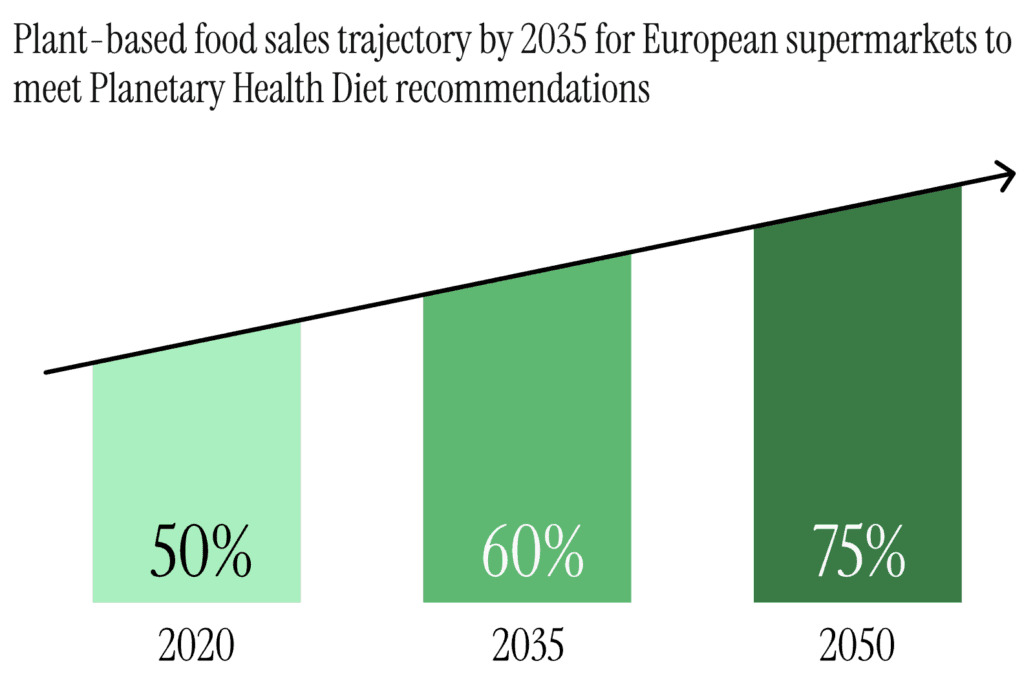
European supermarkets are being pushed to do more than stock plant-based options. At a Berlin summit on 24 April 2026, more than 25 civil society organizations from 12 European countries launched Plant-Rich Europe, a declaration led by Madre Brava, ProVeg International, the World Resources Institute, and WWF that asks retailers to measure, disclose, set targets, and take action on the plant-to-animal food sales ratio.
That framing matters because it shifts the protein transition from a consumer preference story to a retail accountability story. The coalition wants supermarkets to track how much of their food sales come from plant sources and to make that mix part of climate strategy. The Berlin event drew representatives from Ahold Delhaize, REWE, Lidl, Tesco, and Migros, putting some of Europe’s most influential grocers in the same room as the groups pressing for a faster reset in shelf strategy.
The coalition’s benchmarks are blunt. It argues that if 75% of food sales are meant to be plant-based by 2050, then supermarkets should already be at least 60% plant-based by 2035. Within that, protein-source food sales should be at least 33% plant-based by 2035, while dairy should account for no more than 29% of all food sales by that date. The declaration aligns with the EAT-Lancet Commission’s Planetary Health Diet, which is built around a science-based pattern intended to support human health and the planet.
What supermarkets do next is the real test. Madre Brava says retailers can shape demand through product availability, pricing, placement, and promotions, which means the battle is not just about whether plant proteins exist on the shelf, but where they sit, how often they are discounted, and whether private-label ranges are built to compete on price and convenience. The group also argues that continued dependence on animal-based foods leaves supermarkets exposed to climate, land, water, and supply-chain risks, while plant-rich sales can help families under cost-of-living pressure.
Some chains are already moving. Madre Brava says Lidl has public plant-protein split targets in six European countries, including Austria, Belgium, Germany, Luxembourg, the Netherlands, and Switzerland. It says Ahold Delhaize confirmed that by the end of 2024 all of its food retail brands in Europe would set targets to sell a higher proportion of plant proteins and fewer animal-sourced foods. Albert Heijn, Ahold Delhaize’s Dutch banner, had a 44.1% plant and 55.9% animal protein split in 2023 and is aiming for 60% plant and 40% animal by 2030.
The pressure is building for a reason. Madre Brava says meat sales in Dutch retail stores have fallen 16.4% since 2020 after commitments from the country’s seven largest food retailers. It also says a 50% shift to plant proteins by six major food retailers and food-service companies could cut greenhouse gas emissions by 31.6 million tonnes a year, roughly the equivalent of removing more than 25 million cars from EU roads.
This article was produced by Prism’s automated news system from verified source data, official records, and press releases, then run through automated quality and moderation checks before publishing. The system is built and supervised by the people who set the standards it runs under. Read our full AI policy.
Did this article answer your question?