Food-waste proteins could replace petroleum in packaging and CO2 capture
Food-waste proteins are moving from discarded feedstock to packaging film and CO2-capture hardware, but consistency and cost still decide whether they scale.
Food waste is not just a disposal problem anymore
The smartest pitch in this space is not that proteins can do one neat lab trick. It is that protein-rich food waste can be depolymerized and reassembled into a whole materials platform, from packaging and coatings to biosensors and carbon-capture media. That is the shift the new Nature Reviews Materials review makes clear: the prize is not a niche protein story, but a circular-economy play that can pull low-value side streams into high-value industrial products.
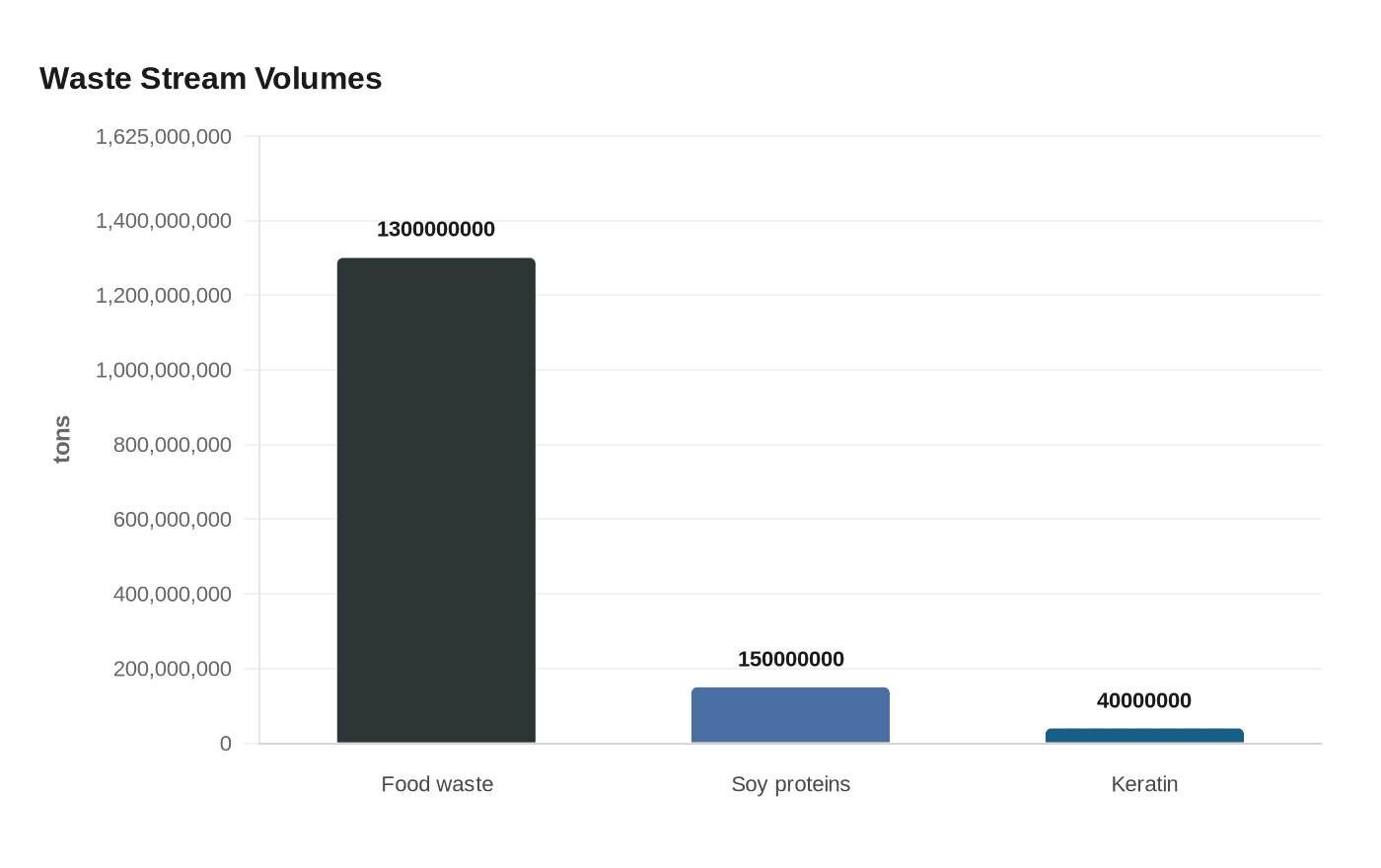
The stakes are huge. The Food and Agriculture Organization of the United Nations has estimated that roughly one-third of food produced for human consumption is lost or wasted globally, equal to about 1.3 billion tons a year. On top of that, materials from the UN Environment Programme, UN Climate Change, and the World Resources Institute put food loss and waste at about 8% to 10% of annual global greenhouse-gas emissions. A 2023 Chemical Reviews paper sharpened the point further: for every kilogram of food protein wasted, between 15 and 750 kg of CO2 can end up in the atmosphere. That is an ugly footprint for something that usually gets treated as landfill fodder.
Why packaging is the first real battleground
Packaging is where this story gets practical fast, because the circularity problem is already painfully visible there. The Ellen MacArthur Foundation has been blunt about the bottlenecks: flexible plastic packaging and weak collection and recycling infrastructure still block full circularity, even as brands and converters have been pushed toward recyclable, compostable, or reusable packaging under the Global Commitment launched in 2018 with 2025 targets.
That matters because packaging is exactly where protein-derived materials can make the quickest case for themselves. The new review frames food-waste proteins as candidates for films, coatings, and barriers that can compete with petroleum-derived inputs. The attraction is obvious: proteins bring functional chemistry that can be tuned by folding, fibril formation, crosslinking, and reassembly, which gives material scientists a path to high-performance surfaces without starting from fossil carbon.
The catch is just as obvious. Packaging buyers do not pay for elegance; they pay for barrier performance, machinability, shelf-life protection, and price. If a protein-based film cannot hold oxygen out, run on standard equipment, and survive real supply-chain abuse, it stays a lab demo.
The chemistry is broader than one type of waste stream
The most important lesson from the review is that food-waste proteins are not a single feedstock story. They include multiple streams with different structures and different chemistry, and that diversity is part of the opportunity. Work discussed earlier at Politecnico di Milano put scale to the problem, pointing to wasted soy proteins at roughly 150 million tons and keratin from feathers at about 40 million tons. That is not a boutique supply chain. That is industrial tonnage.
This matters because different proteins map to different products. Some are better suited to flexible films or coatings, where barrier properties and film formation dominate. Others are better raw material for porous structures, microbeads, or adsorbent surfaces, where surface area and mass transfer matter more than toughness. In a circular materials economy, the goal is not to force one protein into every application. It is to sort the stream, process it intelligently, and send each fraction to the highest-value use it can genuinely support.
Proof is moving beyond theory
The most persuasive part of the current wave of research is that it is no longer just about hypothetical biodegradability. In 2025, a Nature paper reported high oxygen-barrier packaging materials made from protein-rich microbial biomass. That is a meaningful milestone because oxygen barrier is one of the hardest requirements in food packaging, especially for products that need a long shelf life without leaning on conventional multilayer petrochemical films.
Even more striking, a 2025 preprint from the group led by Raffaele Mezzenga at ETH Zürich reported food-waste-derived amyloid fibril microbeads for direct-air CO2 capture. The material reached up to 2.20 mmol g1 of CO2 under ambient air, regenerated in 10 to 12 minutes with alternating dilute acid-alkali mist, required no thermal input, and stayed stable over 30 cycles. That combination matters because capture media often fail on one of three fronts: capacity, regeneration energy, or durability. Here, the material is trying to solve all three at once.
That is the real commercial signal. If a protein-derived material can handle direct-air capture, or deliver high oxygen barrier in packaging, it stops being a speculative sustainability concept and starts looking like an engineered functional material.
What still blocks scale
The usual sustainability marketing line is that once the chemistry works, scale will follow. It almost never works that way. The first hurdle is feedstock consistency. Food waste is messy by definition, and protein quality, moisture, contamination, and fraction composition will vary by source, season, and collection system. A fermentation-derived biomass stream may be more controllable than mixed municipal food waste, but even then, industrial buyers will want tight specs and repeatable performance lot after lot.
The second hurdle is processing cost. Depolymerizing and reassembling proteins into useful materials is not free, and the more steps you add, the harder it is to compete with long-established petrochemical incumbents that benefit from massive scale and mature equipment. If extraction, purification, and post-processing eat up the environmental benefit, the circular story starts to fray.
Then comes performance. Packaging has to do more than sound green. It has to match or beat petrochemical films on oxygen barrier, moisture resistance, sealability, shelf life, and processability. Carbon-capture media have a different hurdle, but it is just as unforgiving: they need enough capacity, fast regeneration, and multi-cycle stability to make the operating economics work.
The business case is circular, not sentimental
This is where the review is most useful. It does not sell protein waste as a miracle substitute for oil. It treats it as part of a materials roadmap, one that turns side streams into products with higher value than feed or landfill. That includes packaging, coatings, biosensors, and carbon-capture applications, all of which depend on protein’s ability to be reorganized into functional structures.
That framing is the right one. Circular materials win when they are not merely greener versions of a commodity, but when they solve an actual industrial pain point. Flexible packaging is under pressure. Carbon capture is hungry for low-energy sorbents. Both are looking for materials that can do more with less fossil input. Food-waste proteins can plausibly fit that gap, but only if collection systems improve, processing gets cheaper, and performance stays competitive with the petrochemical defaults already embedded in the market.
The opportunity is real, and so are the obstacles. The next phase will not be decided by promise alone. It will be decided by whether these protein streams can leave the lab, survive plant-floor economics, and earn a place in products that customers already trust.
This article was produced by Prism’s automated news system from verified source data, official records, and press releases, then run through automated quality and moderation checks before publishing. The system is built and supervised by the people who set the standards it runs under. Read our full AI policy.
Know something we missed? Have a correction or additional information?
Submit a Tip