Maple Leaf Foods leans on poultry and prepared foods momentum
Poultry is doing the heavy lifting at Maple Leaf Foods, and the quarter shows how prepared foods can turn that scale into steadier profit.
Poultry is the growth engine
Maple Leaf Foods Inc. just gave the protein market a clean example of where the momentum is showing up: poultry first, prepared foods right behind it. In first-quarter 2026, revenue rose 6.2% to C$962.9 million from C$906.7 million a year earlier, adjusted EBITDA increased 5.7% to C$122.4 million, and earnings from continuing operations jumped to C$46.1 million from C$16.0 million. The standout inside the print was poultry, where sales climbed 11.7%, while prepared foods also moved ahead with 2.3% growth.
That split matters because it mirrors what has been working across the protein aisle. Poultry tends to win when consumers are looking for affordable protein, and it also benefits from an integrated, value-added setup that can keep more of the margin inside the system. Maple Leaf’s quarter suggests that combination is still doing real work, not just sounding good in a presentation.
The new structure is the point, not just the backdrop
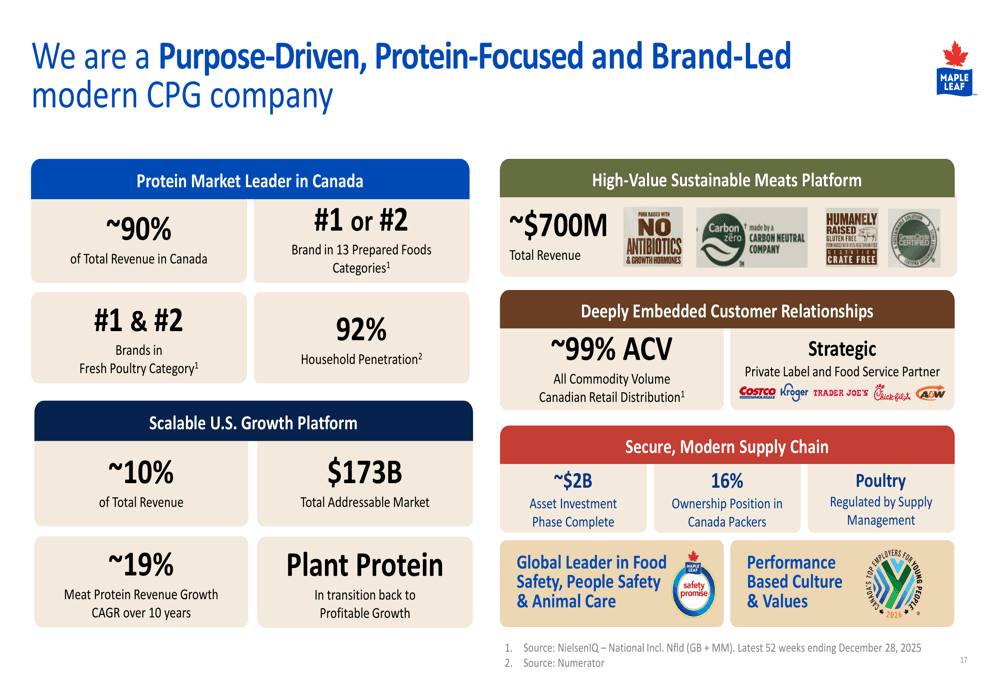
Maple Leaf now says its continuing operations are built around two operating units: Prepared Foods and Poultry. The Poultry unit now includes both fresh and further processed poultry categories, which is a cleaner way to organize the business than the older three-unit model that also included Pork. This is not a cosmetic reshuffle. It is a deliberate reset around the parts of the portfolio with the clearest strategic value.
That simplification matters because it shows management is trying to line up the company around the businesses that can actually carry the next phase of growth. Pork is out of the picture after the spin-off, and the remaining structure is easier to read: one unit focused on branded, higher-margin prepared foods, and another built around poultry scale and processing depth. For investors, that kind of clarity tends to matter when the broader protein cycle is uneven.
Prepared foods still does the margin work
Poultry may be the fastest-moving piece right now, but prepared foods remains the anchor. In Maple Leaf’s full-year 2025 reporting, continuing operations were about 75% Prepared Foods and 25% Poultry, and the company said prepared foods represented approximately 75% of annual revenues for both 2025 and 2024. That gives you a very clear picture of the business mix: poultry is the growth lever, but prepared foods is still the bigger engine in the revenue base.
The 2025 numbers make the case even better. Revenue grew nearly 8%, adjusted EBITDA rose 21%, and adjusted EBITDA margin reached 12.2%. That kind of margin expansion is what prepared foods is supposed to do when it is executed well. It takes raw protein, turns it into branded, easier-to-merchandise offerings, and gives retailers a product that is simpler to place and shoppers a product that is easier to buy.
Why poultry is outperforming the messier parts of protein
The broader industry signal here is not hard to read. Beef remains constrained, costs across protein can be volatile, and shoppers are still balancing nutrition, convenience, and price. In that kind of market, poultry usually looks more dependable than the slower or noisier categories, and Maple Leaf’s quarter fits that pattern cleanly.
What makes this quarter more interesting is that it also shows how poultry and prepared foods can work together instead of competing for attention. Poultry gives the business scale and volume growth. Prepared foods gives it branding, merchandising power, and a better shot at margins that hold up when raw commodity conditions get choppy. That is the kind of mix that can keep a protein company moving even when the rest of the shelf is less predictable.
Management is signaling confidence, not just stability
Maple Leaf said it is on track with its 2026 outlook, which is the kind of line that matters because it suggests the restructuring has not disrupted operations. After a major shift like this, the question is always whether the business can keep momentum while the org chart is being simplified. So far, the answer looks like yes.
Curtis Frank has framed the transformation as a move toward a simpler, purpose-driven, protein-centric, brand-led consumer packaged goods company, with the goal of unlocking shareholder value. That language lines up with the quarter’s operating pattern: fewer moving parts, clearer business lines, and a stronger emphasis on the categories that can actually carry growth. David Smales also joins the conversation through the company’s results call process, which was set for May 7, 2026 at 8:00 a.m. ET, underscoring how closely management is tying the strategy to the numbers.
What the quarter says about the protein trade
For anyone watching the protein sector, Maple Leaf’s first quarter is useful because it shows where the dependable growth is coming from right now. Poultry is not just participating, it is leading the charge. Prepared foods is still doing the unglamorous but valuable work of turning volume into something more defensible, more branded, and more profitable.
The takeaway is straightforward: companies that can pair poultry scale with prepared-foods innovation are in the best position to stay stable while the rest of protein stays volatile. Maple Leaf’s reset suggests that structure matters, but only if demand is already there in the businesses that remain. Right now, poultry and prepared foods look like the parts of the portfolio with the clearest runway, and the quarter shows exactly why.
This article was produced by Prism’s automated news system from verified source data, official records, and press releases, then run through automated quality and moderation checks before publishing. The system is built and supervised by the people who set the standards it runs under. Read our full AI policy.
Did this article answer your question?